

For the first time in four years, the number of violent crimes in the nation increased when compared with the previous year’s statistics, erasing all declines achieved during the presidency of Donald Trump according to figures released by the FBI.
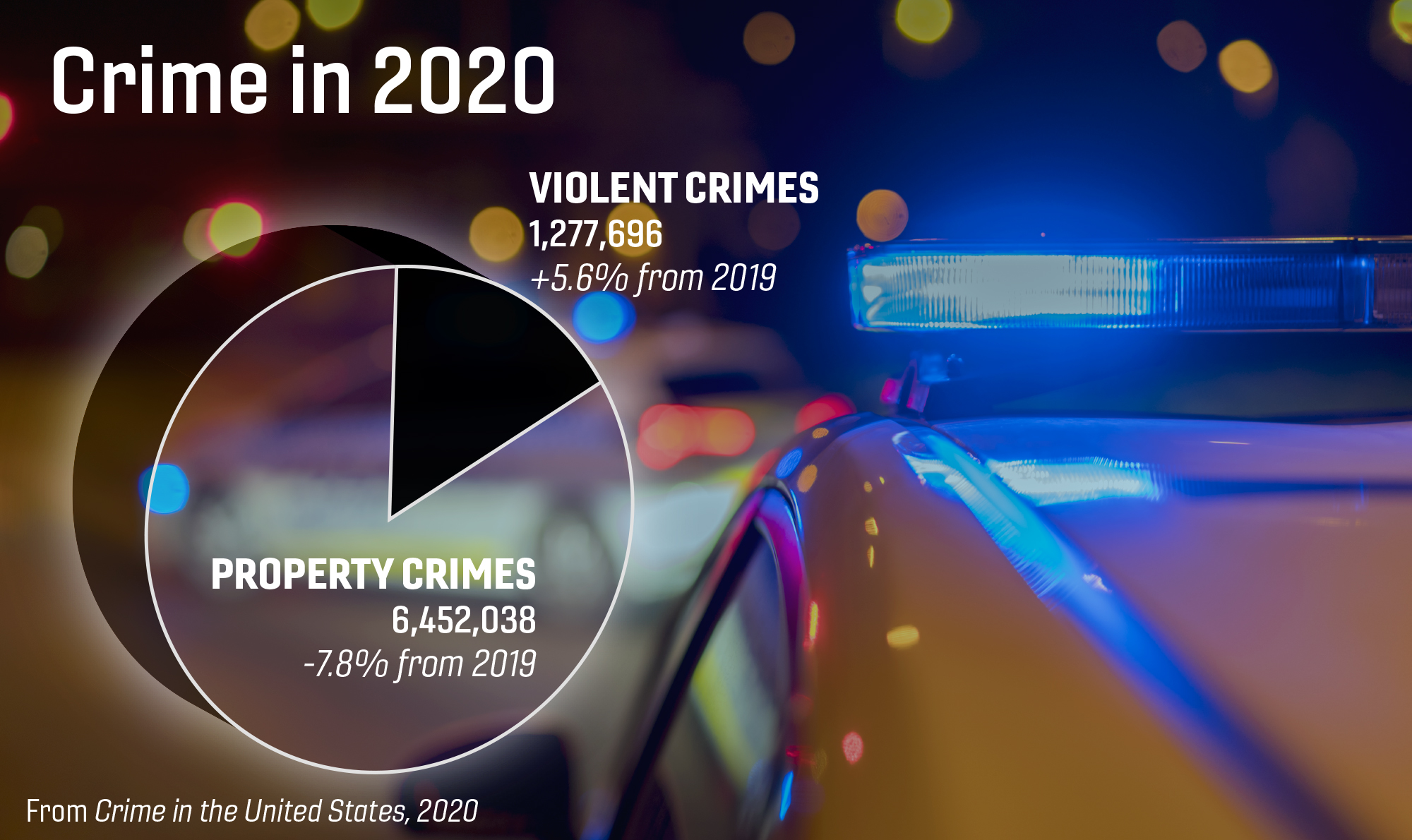
In 2020, violent crime was up 5.6 percent from the 2019 number and the overall violent crime rate was higher when Trump left office compared to when he was elected in 2016.
Property crimes dropped 7.8 percent, marking the 18th consecutive year the collective estimates for these offenses declined.
The violent crime rate rose 5.2 percent when compared with the 2019 rate; the property crime rate declined 8.1 percent.
The 2020 statistics show the estimated rate of violent crime was 387.8 offenses per 100,000 inhabitants, and the estimated rate of property crime was 1,958.2 offenses per 100,000 inhabitants.
These and additional data are presented in the 2020 edition of the FBI’s annual report Crime in the United States.
This report is available as downloadable spreadsheets and topic pages about offenses, arrests, and police employee data reported by law enforcement agencies voluntarily participating in the FBI’s Uniform Crime Reporting (UCR) Program.
The UCR Program collects information on crimes reported by law enforcement agencies regarding the violent crimes of murder and nonnegligent manslaughter, rape, robbery, and aggravated assault, as well as the property crimes of burglary, larceny-theft, motor vehicle theft, and arson.
The FBI classifies arson as a property crime but does not estimate arson data because of variations in the level of participation by the reporting agencies. Consequently, arson data is not included in the property crime estimate.
The program also collects arrest data for the offenses listed above and 20 offenses that include all other crimes except traffic violations.

Of the 18,619 federal, state, county, city, university and college, and tribal agencies eligible to participate in the UCR Program, 15,897 agencies submitted data in 2020.
In 2020, the FBI estimated crime statistics for New Jersey were based on data received from all 577 law enforcement agencies in the state that year.
A high-level summary of the statistics submitted, as well as estimates for those agencies that did not report, follows:
- In 2020, there were an estimated 1,277,696 violent crimes. When compared with the estimates from 2019, the estimated number of robbery offenses fell 9.3 percent and the estimated volume of rape (revised definition) offenses decreased 12.0 percent. The estimated number of aggravated assault offenses rose 12.1 percent, and the volume of murder and nonnegligent manslaughter offenses increased 29.4 percent.
- Nationwide, there were an estimated 6,452,038 property crimes. The estimated numbers for two of the three property crimes showed declines when compared with the previous year’s estimates. Burglaries dropped 7.4 percent, larceny-thefts decreased 10.6 percent, while motor vehicle thefts rose 11.8 percent.
- Collectively, victims of property crimes (excluding arson) suffered losses estimated at $17.5 billion in 2020.
- The FBI estimated law enforcement agencies nationwide made 7.6 million arrests, (excluding those for traffic violations) in 2020.
- The arrest rate for violent crime was 147.9 per 100,000 inhabitants, and the arrest rate for property crime was 267.3 per 100,000 inhabitants.
- By violent crime offense, the arrest rate for murder and nonnegligent manslaughter was 3.8 per 100,000 inhabitants; rape (aggregate total using the revised and legacy definition), 6.3; robbery, 21.0; and aggravated assault, 116.8 per 100,000 inhabitants.
- Of the property crime offenses, the arrest rate for burglary was 45.7 per 100,000 inhabitants; larceny-theft, 193.1; and motor vehicle theft, 25.5. The arrest rate for arson was 3.0 per 100,000 inhabitants.
- In 2020, 13,377 law enforcement agencies reported their staffing levels to the FBI. These agencies reported that, as of October 31, 2020, they collectively employed 696,644 sworn officers and 309,135 civilians—a rate of 3.4 employees per 1,000 inhabitants.
Each year when Crime in the United States is published, some entities use the figures to compile rankings of cities and counties. These rough rankings provide no insight into the numerous variables that mold crime in a particular town, city, county, state, tribal area, or region.
Consequently, they lead to simplistic and/or incomplete analyses that often create misleading perceptions adversely affecting communities and their residents.
Valid assessments are possible only with careful study and analysis of the range of unique conditions affecting each local law enforcement jurisdiction.
The data user is, therefore, cautioned against comparing crime data of individual reporting units from cities, metropolitan areas, states, or colleges or universities solely on the basis of their population coverage or student enrollment.
The downloadable files of Crime in the United States, 2020, are available on the UCR’s Crime Data Explorer.
Discover more from NJTODAY.NET
Subscribe to get the latest posts sent to your email.