



In 1994, a joint NASA and Department of Defense (DOD) mission called Clementine dramatically changed our view of the Moon.
As the first U.S. mission to the Moon in more than two decades, Clementine’s primary objectives involved technology demonstrations to test lightweight components and sensor performance.
The lightweight sensors aboard the spacecraft returned 1.6 million digital images, providing the first global multispectral and topographic maps of the Moon.
Data from a radar instrument indicated that large quantities of water ice may lie in permanently shadowed craters at the lunar south pole, while other polar regions may remain in near-permanent sunlight.
It was designed to test spacecraft components during extended exposure to space and to study the Moon and an asteroid
Although a technical problem prevented a planned flyby of an asteroid, Clementine’s study of the Moon proved that a technology demonstration mission can accomplish significant science.
Specifically, Clementine was a technology-proving mission for the DOD’s Brilliant Pebbles program for the Strategic Defense Initiative (SDI), which required a large fleet of inexpensive spacecraft. Clementine carried 15 advanced flight-test components and nine science instruments.


After launch, the spacecraft remained in a temporary parking orbit until Feb. 3, 1994, at which time a solid-propellant rocket ignited to send the vehicle to the Moon.
After two Earth flybys, Feb. 5 and Feb. 15, Clementine successfully entered an elliptical polar orbit (about 270 × 1,830 miles or 430 × 2,950 kilometers) around the Moon on Feb. 19, 1994, with a period of five days.
In the following two months, it transmitted about 1.6 million digital images of the lunar surface, many of them with resolutions down to about 330-660 feet (100-200 meters). In the process, it provided scientists with their first look at the total lunar landscape including polar regions.
After completing its lunar mission goals during 297 orbits, controllers fired Clementine’s thrusters May 3, 1994, to inject it on a rendezvous trajectory (via an Earth flyby) with the asteroid 1620 Geographos in August 1994.
However, due to a computer problem at 14:39 UT May 7, 1994, that caused a thruster to fire and use up all propellant, the spacecraft was put in an uncontrollable tumble at about 80 rpms with no spin control. Controllers were forced to cancel the asteroid flyby and return the vehicle to the vicinity of Earth.
A power supply problem further diminished the operating capacity of the vehicle. Eventually, on July 20, 1994, lunar gravity took control of Clementine and propelled it into a heliocentric orbit.
The mission was terminated Aug. 8, 1994, when falling power supply levels no longer allowed clear telemetry exchange.
Surprisingly, because the spacecraft was fortuitously in the correct attitude to power up again, ground controllers were able to briefly regain contact between Feb. 20, 1995, and May 10, 1995.
On Dec. 3, 1996, the Department of Defense announced that Clementine data indicated that there was ice in the bottom of a permanently shadowed crater at the lunar South Pole.
The Moon has no atmosphere, any substance on the lunar surface is exposed directly to a vacuum. For water ice, this means it will rapidly sublime directly into water vapor and escape into space, as the Moon’s low gravity cannot hold gas for any appreciable time.
Over a lunar day (~29 Earth days), all regions of the Moon are exposed to sunlight, and the temperature on the Moon in direct sunlight reaches about 395 Kelvin, which is equal to about 250 degrees Fahrenheit or 122 degrees Celsius. So any ice exposed to sunlight for even a short time would be lost. The only possible way for ice to exist on the Moon would be in a permanently shadowed area.
Scientists estimated the deposit to be approximately 78,500 to 157,000 cubic yards (60,000 to 120,000 cubic meters) in volume, or comparable to a small lake that is four football fields in surface area and about 16 feet (5 meters) deep. This estimate was very uncertain, however, due to the nature of the data.
An accounting of Clementine’s legacy should include the fact that methods developed for the project became the basis for NASA’s “Faster, Better, Cheaper” initiative which ultimately paved the way for the Agency’s Discovery program.
The spacecraft spent eight days in low Earth orbit checking out its systems. On Feb. 3, a solid rocket motor fired to place it on a lunar phasing loop trajectory that included two Earth flybys to gain enough energy to reach the Moon.
During the first orbit, the spacecraft jettisoned the Interstage Adapter Subsystem that remained in a highly elliptical Earth orbit for three months collecting radiation data as it passed repeatedly through the Van Allen radiation belts.
On Feb. 19, Clementine fired its own engine to place the spacecraft into a highly elliptical polar lunar orbit with an 8-hour period. A second burn two days later placed Clementine into its 5-hour mapping orbit.
The first mapping cycle began on Feb. 26, lasting one month, and the second cycle ended on April 21, followed by special observations.
During the first month of mapping, the low point of Clementine’s orbit was over the southern hemisphere to enable higher resolution imagery and laser altimetry over the south polar regions. Clementine adjusted its orbit to place the low point over the northern hemisphere for the second month of mapping to image the north polar region at higher resolution. Clementine spent the final two weeks in orbit filling in any gaps and performing extra studies looking for ice in the north polar region. For 71 days and 297 lunar orbits, Clementine imaged the Moon, returning 1.6 million digital images, many at a resolution of 330 feet. It mapped the Moon’s entire surface including the polar regions at wavelengths from near ultraviolet through visible to far infrared. The laser altimetry provided the first global topographic map of the Moon. Similar data from Apollo missions only mapped the equatorial regions of the Moon that lay under the spacecraft’s orbital path. Radio tracking of the spacecraft refined our knowledge of the Moon’s gravity field.
A finding with significant application to future exploration missions, Clementine found areas near the polar regions where significant amounts of water ice may exist in permanently shadowed crater floors. Conversely, Clementine found other regions near the poles that may remain in near perpetual sunlight, providing an abundant energy source for future explorers. The Dec. 16, 1994, issue of Science, Vol. 266, No. 5192, published early results from Clementine. The Clementine project team assembled a series of lessons learned from the mission to aid future spacecraft development and operations.


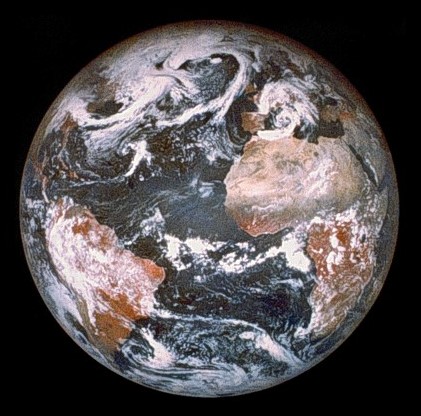
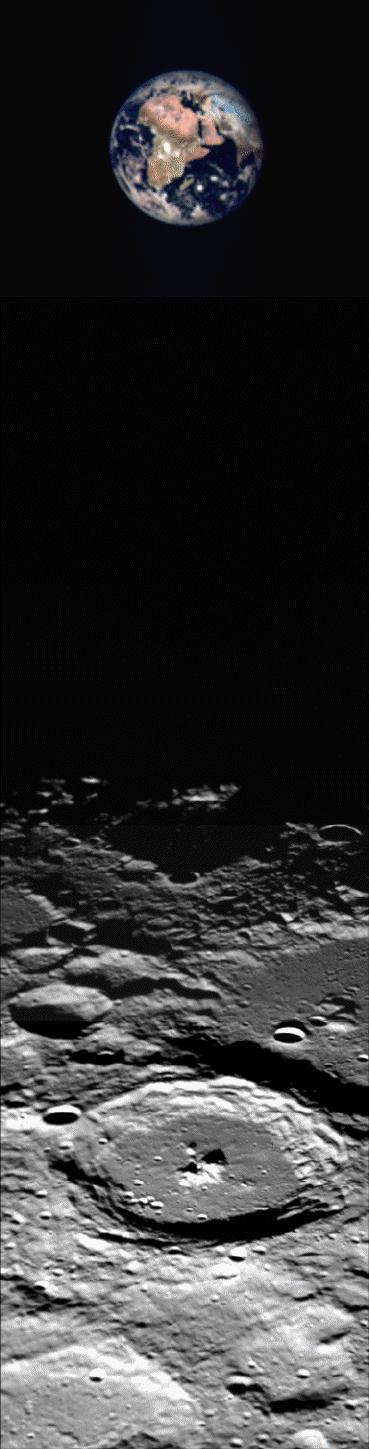
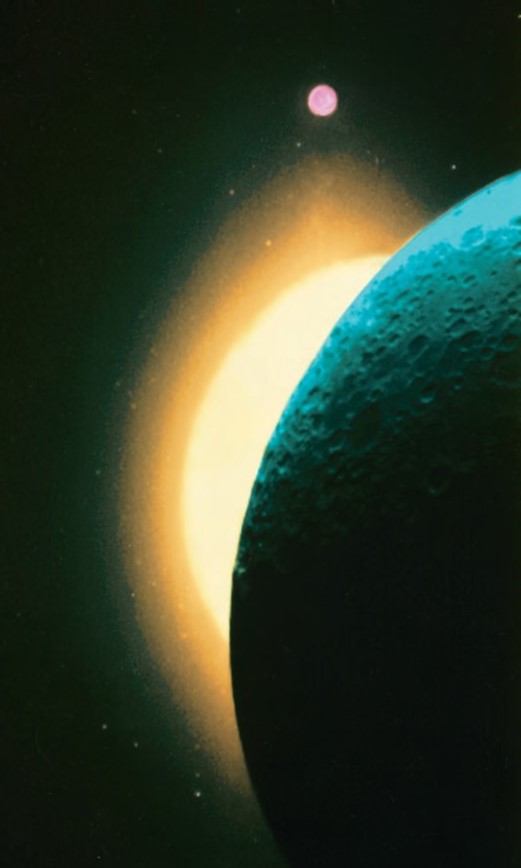
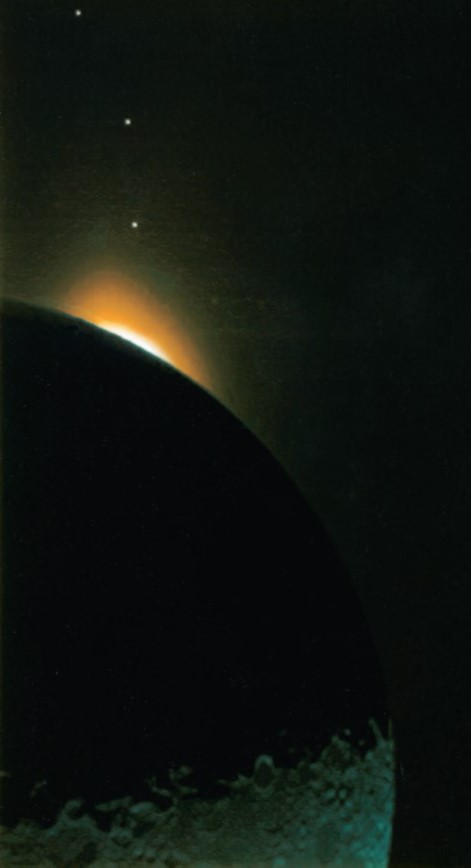
Left: Middle left: Colorized image of the full Earth over the lunar north pole. Middle right: Color enhanced view of the Moon lit by Earth shine, the solar corona, and the planet Venus. Right: Color enhanced image of the Earthlit Moon, the solar corona, and the planets Saturn, Mars, and Mercury.
Its Moon observation time over, Clementine left lunar orbit on May 5, heading for Geographos via two more Earth gravity-assist flybys. Unfortunately, two days later a computer glitch caused one of the spacecraft’s attitude control thrusters to misfire for 11 minutes, expending precious fuel and sending Clementine into an 80-rotations-per-minute spin.
The problem would have significantly reduced data return from the asteroid flyby planned for August and managers decided to keep the spacecraft in an elliptical geocentric orbit.
A power supply failure in June rendered Clementine’s telemetry unintelligible. On July 20, lunar gravity propelled the spacecraft into solar orbit and the mission officially ended on Aug. 8. Ground controllers briefly regained contact between Feb. 20 and May 10, 1995, but Clementine transmitted no useful data.
Despite the loss of the Geographos flyby, Clementine left a lasting legacy. The mission demonstrated that a flight primarily designed as a technology demonstration can accomplish significant science.
The data Clementine returned revolutionized our knowledge of lunar history and evolution. The discovery of the unique environments at the lunar poles, including the probability of large quantities of water ice in permanently shadowed regions there, changed the outlook for future scientific missions and human exploration.
Subsequent science missions, such as NASA’s Lunar Prospector and Lunar Reconnaissance Orbiter, China’s Chang’e spacecraft, and India’s Chandrayaan spacecraft, all built on the knowledge that Clementine first obtained.
Current uncrewed missions target the lunar polar regions to add ground truth to the orbital observations, and NASA’s Artemis program intends to land the first woman and the first person of color in that region as a step toward sustainable lunar exploration.