

By John Bos – “Connecting the Dots”
One of the things that aging brings is remembering the people and events that have impacted our lives in one way or another. There are some things you never forget. In my life four dates will remain unforgettable. For personal and global reasons.
February 12: I was born on February 12 (1936) in Dr. Jenny’s home hospital in an old Victorian house in Tonawanda, NY. Medical historian Judy Leavitt, a professor emeritus at the University of Wisconsin-Madison, traces the history of fathers and childbirth in her book “Make Room for Daddy: The Journey from Waiting Room to Birthing Room.” Getting fathers into delivery rooms didn’t happen overnight, and progress across the country was uneven, Leavitt found. By the 1960s, fathers were regularly allowed in the room during labor. By the 70s and 80s, they were allowed to stay for the birth. Today, most do. Our father was there for our mother in 1936, 1938 (Pete) and 1940 (Chuck). I believe this is one of the many shared experiences that strengthened our parent’s bonds and also gave our father an intimate and meaningful start to his fatherhood.
On February 12 (1809), Abraham Lincoln, the 16th President of the United States was also born. It was Lincoln, of course, who led the nation during the Civil War and worked to end slavery. During his first address as president, he tried to assure the South that slavery would not be interfered with, and to quiet the drumbeat of war by appealing to “the better angels of our nature.” That phrase became Braver Angels (formerly Better Angels), a New York-based 501(c)(3) nonprofit dedicated to political depolarization. The organization runs workshops, debates, and other events where “red” (conservative) and “blue” (liberal) participants attempt to better understand one another’s positions and discover their shared values. https://braverangels.org/
August 6: Is the date (1960) I married a fabulous person and painter who still gets into her SoHo studio to work at 3 am each morning at age 88.
However, this joyful personal event has long been overshadowed by the grim global history resulting from the dropping of the atomic bomb “Little Boy” on Hiroshima, Japan (1945) by the United States. Tens of thousands of people were killed in the initial explosions (an estimated 70,000 in Hiroshima and 40,000 in Nagasaki), and many more later succumbed to burns, injuries, and radiation poisoning.
The atomic bombings resulted in global impacts such as the Cold War and the proliferation of nuclear weapons throughout the world.

The Cold War rivalry between the world’s two remaining superpowers – the United States and the Soviet Union, as well as their respective allies – became a fight for political, economic, and nuclear superiority. Currently, there are estimated to be 9,585 nuclear warheads in military stockpiles for potential use across nine countries, with Russia and the U.S. accounting for 8,088 of these. There are also an estimated 2,536 retired warheads that are yet to be dismantled. Thankfully, these weapons have not been used in warfare since the bombings of Hiroshima and Nagasaki. That said, Albert Einstein, J. Robert Oppenheimer, and other scientists who helped develop the first atomic weapons created the Doomsday Clock.
This Bulletin of the Atomic Scientists Clock has become a universally recognized indicator of the world’s vulnerability to global catastrophes caused by man-made technologies. The Clock is set to 90 seconds to midnight – the closest to global catastrophe it has ever been – in large part because of Russian threats to use nuclear weapons in the war in Ukraine.
September 11: Americans watched in horror as the terrorist attacks on Sept. 11, 2001, left 2,977 people dead in New York City, Washington, D.C., and Shanksville, Pennsylvania.
On that unforgettable day, I spent nearly three hours in vain attempts to reach my son Chis and his family who lived 11 blocks north of the World Trade Center. Telephone lines were down as were cell phone connections.

Chris was finally able to reach meand assure me that his wife, two sons and my ex were safe. At that time Chris was a videographer making music videos. He quickly took his camera down to the demolished World Trade Center site and captured some unforgettable and unedited, raw footage of the devastation and chaos.
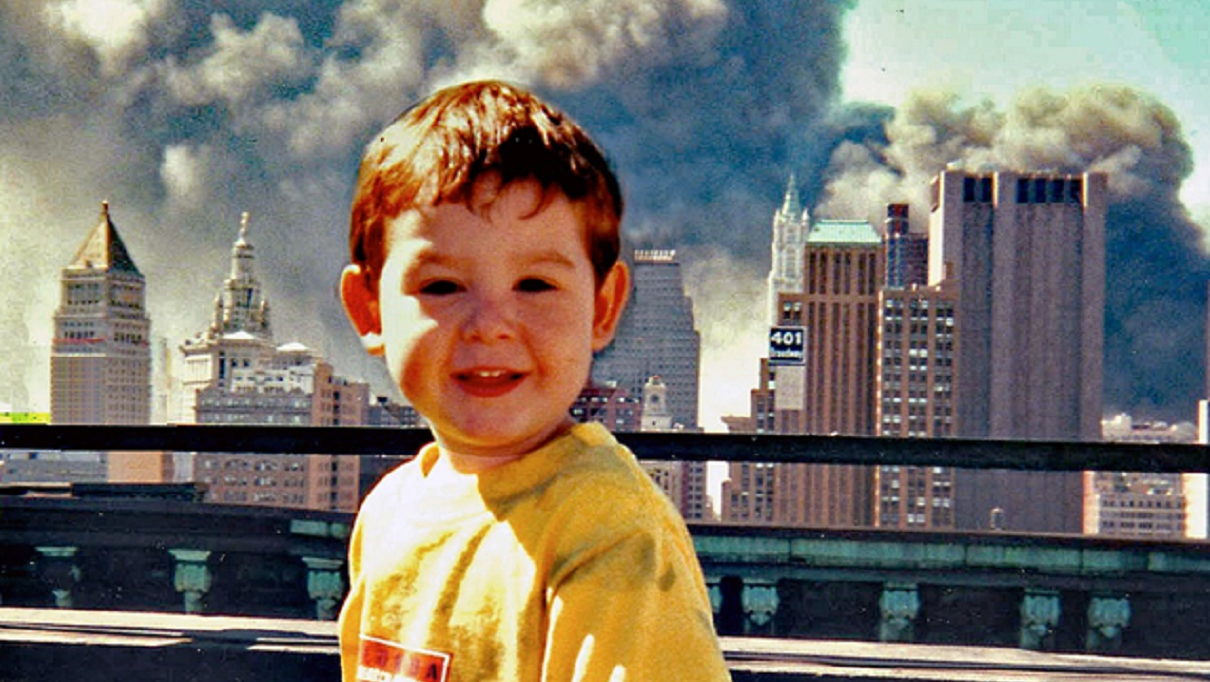
Meantime, back on the rooftop of their SoHo loft, my former wife took a rooftop photo of our oldest grandson who will graduate from Temple University next month. Behind our then 2-year-old grandson are the grey clouds of the Twin Towers.
A review of U.S. public opinion in the two decades since 9/11 reveals how a badly shaken nation came together, briefly, in a spirit of sadness and patriotism; how the public initially rallied behind the wars in Afghanistan and Iraq, though support waned over time; and how Americans viewed the threat of terrorism at home and the steps the government took to combat it.
Yet the public’s initial judgments on that mission are clear. A majority endorsed the decision to withdraw from Afghanistan, even as it criticized the Biden administration’s handling of the situation. And after America’s longest war that cost thousands of lives – including more than 2,000 American service members – and trillions of dollars in military spending, a Pew Research Center survey found that 69% of U.S. adults say the United States has mostly failed to achieve its goals in Afghanistan.
For most of us who are old enough to remember, 9/11 is a day that is impossible to forget. In many ways, 9/11 reshaped how Americans think of war and peace, their own personal safety and their fellow citizens.
November 22: The assassination of President John F. Kennedy in 1963 in Dallas, Texas shocked and traumatized the American public, marking a loss of national innocence and optimism. Many of us viewed it as a defining moment that changed the country’s trajectory.
That same year my wife and I were working in Baltimore. I was serving as the first full time manager of Center Stage, a tiny theatre destined to become one of America’s preeminent regional professional theatres. I so well remember, after absorbing the news, that we had become a banana republic. I remember going to the theatre to post a “no performance tonight” note on the entrance door. There was no electronic means in 1963 by which to alert all our subscribers that the theatre would be closed.

Many saw the killing of Kennedy’s presidency, often romanticized as “Camelot,” as a time of youthful idealism and hope. His assassination abruptly shattered the sense of optimism many Americans felt about the future. Widespread disbelief in the official explanation of Kennedy’s death led to numerous conspiracy theories, contributing to a growing distrust in government institutions.
The assassination of JFK was a pivotal moment that reshaped American politics, culture, and society in ways that continue to resonate decades later. Thirty-two years later (1985) our mother died while in the recovery room at Leesburg, VA Hospital. Mom shared JFK’s birth date (May 29) AND death date (Nov. 22).
It is impossible for me to separate my personal from larger in life memories and experiences. I’m sure that is what led me to call my column “Connecting the Dots.” Aren’t we all trying to find some coherence in our lifetime of experiences, rewarding and unwelcome?
People often frame their personal experiences as part of a larger story or narrative, which naturally leads to drawing connections to universal themes. Being present and attentive to one’s experiences and surroundings can increase our ability to notice patterns and connections between personal events and larger phenomena.
But I must confess that the resonance of these four meaningful dates in my life to the outer world feels like more than coincidence.
John Bos is a columnist for the Greenfield (MA) Recorder and Green Energy Times. His essays have been published in the Springfield (MA) Republican, the Brattleboro Reformer and other regional newspapers. Comments and questions may be sent to john01370@gmail.com.


Leave a Reply