


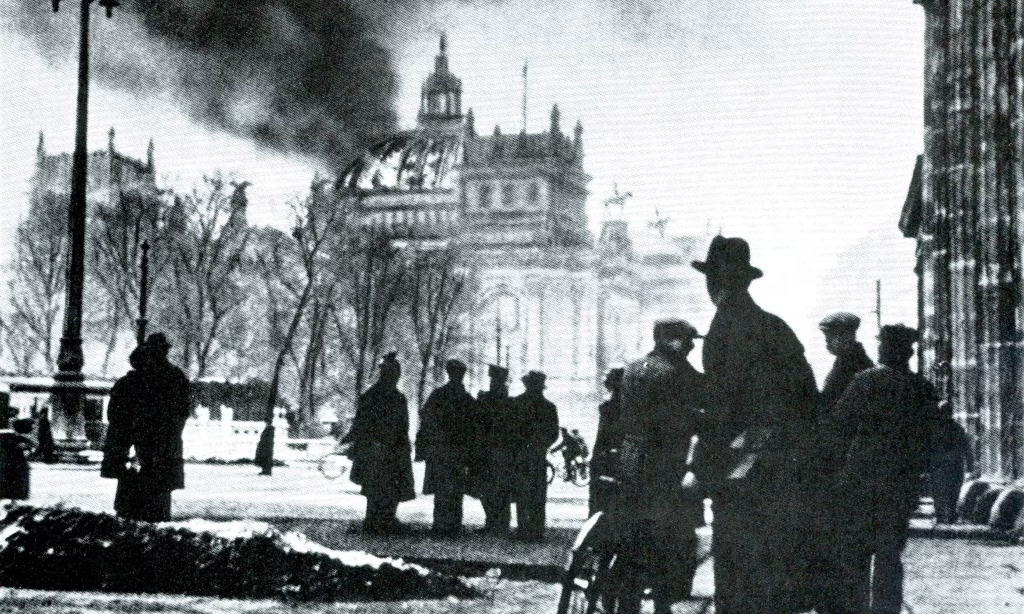
President Donald Trump has put the United States, in some ways, where Germany was in 1933, when Adolf Hitler used the suspicious burning of the German parliament to turn a democracy into a totalitarian state.
As legal scholars and historians mark the 92nd anniversary of the Reichstag fire — the 1933 arson that catalyzed Adolf Hitler’s dictatorship — eerie parallels are emerging in the United States, where allies of Trump openly speculate about leveraging a “national crisis” to justify sweeping executive powers blocked by courts.
The rhetoric mirrors tactics used by the Nazis to dismantle democracy, raising alarms that Trump’s stalled agenda could be revived through manufactured chaos.
The Reichstag Blueprint: From Fire to Führer
On February 27, 1933, Germany’s parliament building erupted in flames.
The Nazis swiftly blamed Marinus van der Lubbe, a Dutch communist, and framed the fire as part of a Bolshevik plot to overthrow the state.
Though historians now widely agree the Nazis likely orchestrated the blaze themselves, Hitler exploited the panic to suspend civil liberties, outlaw opposition parties, and consolidate authoritarian rule via the Reichstag Fire Decree.
The Reichstag fire was the pretext that allowed Hitler to ‘legally’ seize emergency powers. It’s a playbook for autocrats: create or exploit a crisis, declare your opponents terrorists, and then dismantle checks on your power.
Using the incident to convince President Hindenburg to sign the “Reichstag Fire Decree,” which effectively suspended civil liberties, the Nazi government employed this broad authority to suppress political opposition, paving the way for a dictatorship.
Trump’s “Patriot Emergency”: Echoes of 1933
Trump and his allies have floated scenarios that critics call alarmingly reminiscent of 1933.
During his campaign, when asked about “agitators” from abroad, Trump replied: “I think the bigger problem is the enemy within.”
He lamented: “We have some very bad people. We have some sick people, radical left-wing nuts. And I think they are the problem.” The Republican strongman threatened tough action would be taken against them, “if necessary by the National Guard, or if really necessary, by the military”.
While overall support is only 14 percent, Republicans are four times more likely to apprive of pardons for violent Capitol rioters, signaling lingering sympathy for the dramatic upheavals surrounding the 2020 election, which ended in an unprecedented outbreak of violence.
“The Reichstag has been on a slow burn since June,” said Yale historian Timothy Snyder, a top authority on Nazism and Stalinism, speaking in advance of the 2020 election. “The language Trump uses to talk about Black Lives Matter and the protests is very similar to the language Hitler used — that there’s some vague left-wing conspiracy based in the cities that is destroying the country.”
After Trump did not concede defeat but instead incited his supporters with claims of electoral fraud, a mob of terrorists responded with a violent attack on the US Capitol, in Washington, on January 6, 2021.


Examples of “enemies within” included such politicians as Democratic Senator Adam Schiff, who played a prominent role in the impeachment proceedings against Trump, who claimed that his domestic critics are more dangerous than foreign enemies such as China or Russia.
Meanwhile, far-right influencers have amplified conspiracy theories, including the baseless claim that anti-fascist groups are stockpiling weapons for a “Second Civil War.”
There’s an emerging blue-state nightmare: Inspired by Trump’s call to round up immigrants who are in the country illegally, Republican governors could send their National Guard troops into Democratic-led states without permission from leaders in those jurisdictions.
In December, all 26 Republican governors except for Vermont Gov. Phil Scott — vowed to assist Trump with deportations of immigrants “who pose a threat to our communities and national security.” Their pledge included the use of National Guard troops.
Texas signed an agreement with the Trump administration giving the state’s National Guard troops law enforcement powers to arrest and help detain migrants.
Republican Gov. Greg Abbott’s four-year Operation Lone Star program has until now used the National Guard only for surveillance and logistical support for federal agents.
Trump posted on social media a single sentence that reveals his attitude as he tests the nation’s legal and constitutional boundaries in the process of dismantling the federal government and punishing his perceived enemies.
“He who saves his Country does not violate any Law,” Trump wrote on social media platform owned by him and his top advisor, Elon Musk.


“Let’s be clear. There is only one political party in American politics embracing violence,” said Washington Post columnist Dana Milbank. “There is only one side refusing to denounce all political violence. There is only one side talking about bringing guns to the polls; one side attempting to turn federal law-enforcement officials into an arm of a political party. And Trump is trying to use law enforcement to revive tactics historically used to bully voters of color from voting — tactics not seen in 40 years.”
Trump’s actions have violated each of the following laws:
The Protecting Americans from Foreign Adversary Controlled Applications Act of 2024. The Administrative Leave Act of 2016. The Federal Information Security Modernization Act of 2014. The Affordable Care Act of 2010. The Foreign Affairs Reform and Restructuring Act of 1998. The Religious Freedom Restoration Act of 1993. The Computer Fraud and Abuse Act of 1986. The Inspector General Act of 1978. The Privacy Act of 1974. The Impoundment Control Act of 1974. The Rehabilitation Act of 1973. The Federal Advisory Committee Act of 1972. The Immigration and Nationality Act of 1952. The Administrative Procedure Act of 1946. The Public Health Service Act 1944. The Antideficiency Act of 1870.
Like the Nazis’ framing of van der Lubbe, Trump’s inner circle has increasingly blamed isolated acts of violence on shadowy “leftist networks.”
“This is textbook stochastic terrorism,” said Lisa McCormick, one of New Jersey’s leading progressive Democrats. “They’re laying groundwork to blame any future violence on political enemies, then invoke insurrection acts to suppress dissent.”
Speculation about a “Reichstag-style” event intensified after a leaked 2023 memo from the Heritage Foundation’s “Project 2025” suggested a second Trump administration should prepare contingency plans for catastrophic unrest to justify martial law.
While no evidence ties Trump directly to such planning, his rhetoric has grown more incendiary. Far-right extremists have a plan to shatter democracy’s guardrails, giving presidents almost unlimited power to implement policies that will hurt everyday Americans and strip them of fundamental rights.
Legal Firewalls vs. “National Survival”
The Biden-appointed judiciary remains a hurdle. In February, the D.C. Circuit Court ruled 9-2 against Trump’s bid to reactivate a Cold War-era “Emergency Executive” statute, writing that “fearmongering is not a constitutional basis for dictatorship.” Yet Trump’s allies are testing workarounds:
- The “Red Flag” Doctrine: Draft legislation by Rep. Matt Gaetz (R-FL) would allow the president to declare any group “subversive” without judicial review.
- SCOTUS Shadow Docket: Legal analysts warn Trump could exploit the Supreme Court’s conservative majority to fast-track emergency powers claims.
- State-Level Precedents: Florida Gov. Ron DeSantis’s “anti-riot” laws, which criminalize peaceful protests, are seen as a model for federal action.
Historians Sound the Alarm
“The Reichstag fire didn’t happen in a vacuum,” said Dr. Timothy Snyder, author of On Tyranny. “It succeeded because institutions were already weakened by polarization and propaganda. Today, the GOP’s embrace of conspiracy theories and rejection of rule of law creates similar vulnerabilities.”
Civil liberties groups note that Trump’s “Patriot’s Reclamation” order mirrors Hitler’s 1933 Decree: both invoked national security to criminalize dissent, expand surveillance, and neutralize courts.
Conclusion: Democracy’s Stress Test
As Trump vowed retribution in a second term, the specter of a “Reichstag moment” looms — not necessarily as a literal fire, but as any catalyzing event manipulated to justify autocracy.
For now, judicial guardrails hold, but the Republican Party’s apocalyptic tone suggests the stress test is just beginning.
In the words of German journalist Carl von Ossietzky, jailed after the Reichstag fire: “The first thing dictators do is make fear louder than reason.”
This article is a work of speculative analysis based on historical patterns and current political rhetoric. It does not allege specific plans by Donald Trump or his associates.