

The United States can put a stealth bomber through a window over Beijing. It can sink a Chinese carrier group from 3,000 miles away. It has spent more than a trillion dollars preparing for the next great power conflict.
But a new government report this month asks a simpler question. One the generals do not want to answer. Can the Air Force actually fuel the planes?
The Government Accountability Office found that between 2019 and 2025, the aerial refueling fleet consistently fell below its own availability and mission-capability standards.
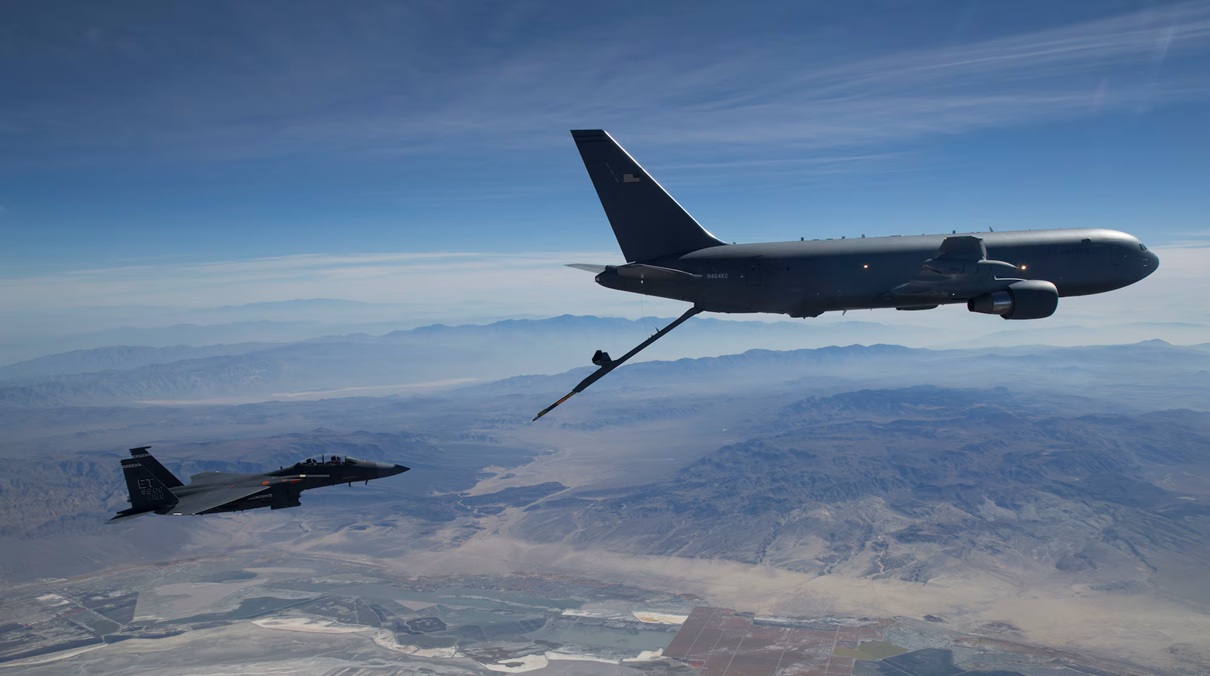
The KC-135 Stratotanker, the backbone of the fleet, is a Cold War aircraft older than the parents of the pilots who fly it. There are currently about 370 to 396 KC-135 Stratotankers still flying and in active service with the U.S. Air Force.
The newer KC-46 Pegasus arrived late, broken, and already outdated. Software that Boeing delivered on the first planes was obsolete the day they landed. More than 100 of them are now in service, and the problems keep coming.
The report cites aging airframes. Spare part shortages that would embarrass a junkyard. Maintenance crews are fully staffed on paper, but three-quarters of them are too inexperienced to work alone. Premature corrosion is eating at both old and new planes.
Frequent equipment failures force crews to cannibalize one aircraft to keep another flying. The practice happened more often than expected for an aircraft early in its service life, the crews told investigators.

Here is the part that should keep every commander awake. The GAO found that the Air Force considers a tanker mission-capable even when its refueling equipment is malfunctioning. As long as the plane can still haul cargo or evacuate wounded, the Air Force marks it ready. The primary mission—putting gas in a fighter over open ocean—becomes a secondary consideration in the paperwork.
The Indo-Pacific is vast. Vaster than most Americans understand. A fighter jet taking off from Guam cannot reach the Taiwan Strait and return without tanker support. Neither can a bomber from Australia. The tankers are the bridge. If the bridge collapses, the planes do not get there. If they get there, they do not get home.
Lyle Goldstein, director of the Asia program at Defense Priorities, said the impact of tankers would be outsized in any Asia-Pacific conflict because of the huge distances and the paucity of available air force bases in the theater.
He also noted that the recent U.S. war with Iran illustrated quite powerfully that aerial tankers can be targeted at forward bases. One may suppose the Chinese armed forces are capable of undertaking strikes against American aerial tankers at a much higher level of intensity than Iran, with both missiles and drones.
The GAO made four recommendations. The Air Force agreed to all of them. That is the Washington equivalent of a patient telling the doctor he will start exercising tomorrow. It costs nothing to concur. Fixing the fleet costs money, time, and political capital, none of which the current administration has shown any interest in spending.
Which brings the story to the Trump administration’s military buffoonery. The record is not a matter of opinion. It is a matter of documented action.
The president purged high-ranking military and national security officials in numbers without precedent in modern American history. The firings were not about performance. They were about loyalty. The deprofessionalization of the armed forces is not a liberal talking point. It is a fact noted by multiple former secretaries of defense, both Republican and Democratic, who served across multiple administrations.
Operational security collapsed into farce. High-level officials shared classified war plans on insecure commercial messaging apps. The compromise did not just leak to the press. It leaked to foreign allies and adversaries alike. Sources told this reporter that specific intelligence sources were burned in the process.
Foreign policy lurched from whim to threat and back again. Tariffs on NATO allies. Threats to take Greenland by force. A trade war with Europe, while simultaneously demanding that Europe help contain China. The incoherence was not strategic. It was the strategy.
The administration repeatedly exaggerated localized unrest to justify deploying active-duty troops onto American streets. The comparisons to autocratic tactics drew condemnation from retired generals who had served under both parties. The condemnations were ignored.
Now the same administration that emptied the Pentagon’s senior ranks is asking the country to believe it can fight a war with China. The GAO says the tanker fleet cannot reliably cross the ocean.
The Space Development Agency, building a constellation of missile-tracking satellites, is overestimating the readiness of its critical technology. The agency is at risk of being unable to deliver capability as quickly as planned, the GAO found. Unplanned work, integration challenges, and schedule delays multiply by the month.
The Chinese, meanwhile, are not standing still. A separate report from the Rand Corporation noted that China likely completed an autonomous in-space refueling of satellites in geosynchronous orbit last year. The Chinese government has not officially confirmed it. The U.S. intelligence community believes it happened.
The GAO report is public. The underlying data is worse. The version released this month omits information that the Department of Defense deemed controlled unclassified. That is Washington’s way of saying the full story is too alarming to print.
Here is the truth the report dances around. America’s ability to project power across the Pacific rests on a bridge of old planes, broken parts, and inexperienced mechanics. The country has spent 20 years fighting insurgents with rifles. It forgot how to fight a country with an air force.
The tanker crews do their jobs. The maintainers work double shifts. The generals do the briefings with straight faces. But the numbers do not lie. Between 2019 and 2025, the fleet failed its own standards. Not for one year. For seven years.
The Air Force considers a tanker mission-capable even when it cannot refuel. By that logic, a fire truck is mission-capable as long as it can still carry the firefighters. The fire keeps burning. The bridge keeps sagging.
And somewhere in Beijing, the planners are reading the same GAO report.
The full document is available at the Government Accountability Office’s website: https://www.gao.gov/assets/gao-26-109154.pdf


Leave a Reply