

By James J. Devine
The same week that 45 million additional people slipped into critical levels of food insecurity, Elon Musk became the world’s first trillionaire, giving new meaning to the concept, “Eat the Rich.”
The milestone came on Friday after SpaceX, his rocket company, completed the largest stock market debut in history. Musk’s net worth now stands at roughly $1.11 trillion, according to Bloomberg.
That puts him nearly four times richer than his nearest rival, Google co-founder Larry Page, and places his personal fortune on par with the entire economic output of Poland.

The scale of this wealth is difficult to conceptualize in everyday terms, prompting widespread criticism from international observers and activists regarding how resources are distributed while basic needs go unmet. The idea that it is time to “Eat the Rich” has thus become a common refrain, symbolizing frustration over the growing divide between a mega-billionaire class and populations facing economic or humanitarian crises.
The hunger crisis experts warned of is here, and it is likely to get worse.
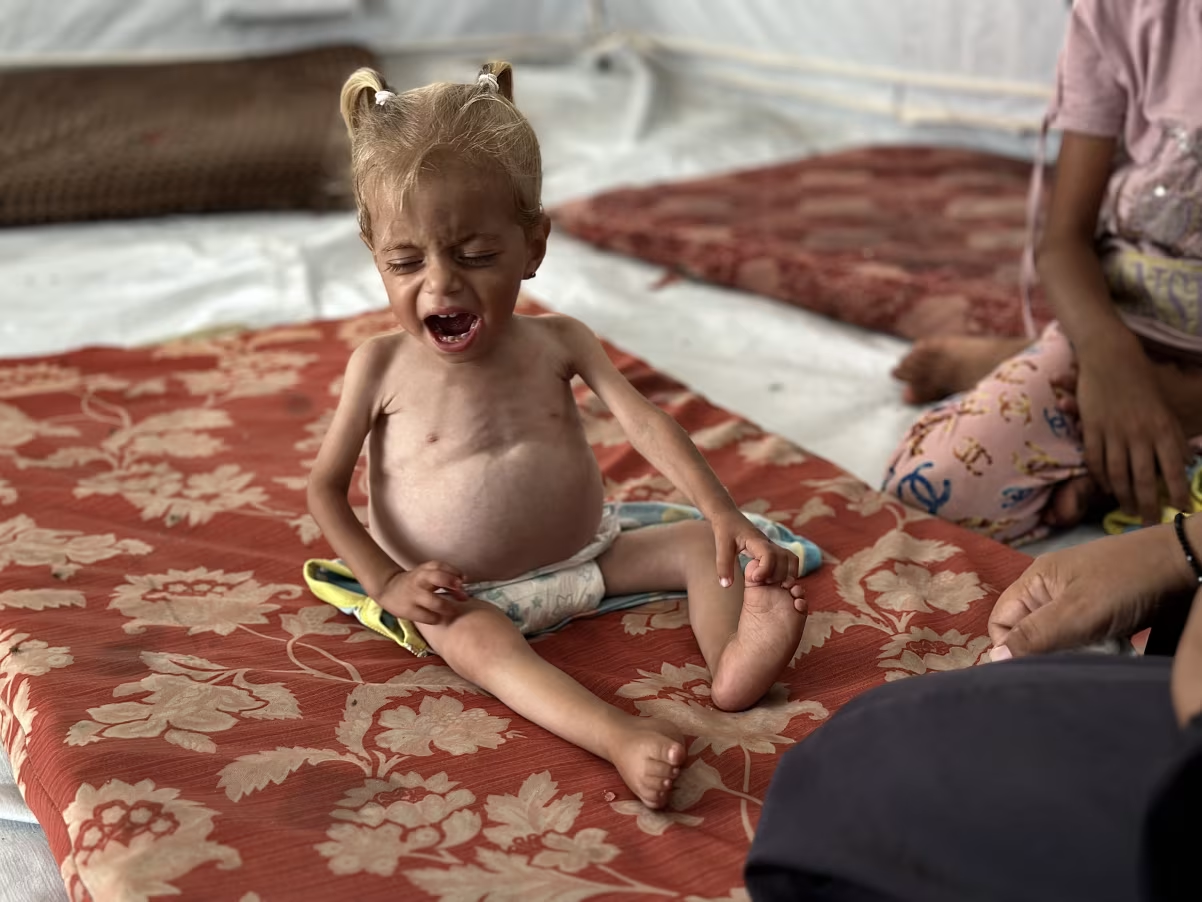
A report produced by the World Food Programme found that 318 million people are facing acute hunger, with 45 million additional people now facing “critical” levels of food insecurity as a direct result of the war in the Gulf.
Across the world, 260 million people already face similar levels. Most live in poor and fragile countries. They cannot meet their basic caloric needs.
Pregnant women in Kabul. Sheep-herders outside Mogadishu. The urban poor in Colombo. These are the front lines.
The crisis revolves around two elements: energy and fertiliser. Both form the backbone of modern farming. A quarter of global oil supplies move through the Strait of Hormuz, along with roughly a third of the world’s fertiliser. The closure has pushed oil to $100 a barrel, up 30 percent since before the war. Fertiliser prices have spiked by 50 percent.
Unlike oil, the world has no strategic reserve for fertilizer. So the cost of producing, distributing, and buying food is now far more expensive.
“The closure of the Strait of Hormuz is not a regional issue,” Dr Qu Dongyu, head of the UN’s Food and Agriculture Organisation Council, said this week. “It is a global food security risk.”
The World Food Programme focused its analysis on three countries: Afghanistan, Somalia, and Sri Lanka. Each shows the same pattern. Families that could afford food six months ago cannot now. Livestock are being sold. Land is being sold. Meals are being skipped.
In Somalia, which imports all of its oil and 90 percent of its grains, the proportion of households that can no longer afford basic cooking oil and grains has risen from 47 to 60 percent since late 2025. An additional 2.5 million Somalis could be unable to afford a basic food basket by year’s end.
In Afghanistan, an estimated 4.9 million mothers and children already suffer from acute malnutrition. Before the war, the World Food Programme could reach only one in four malnourished children. Now it can reach far fewer. Transporting fortified biscuits from Dubai used to take 10 days. It now takes as long as 75 and costs five times more.
“One million kids now can’t be fed just because of the transport issue,” John Aylieff, the World Food Programme’s Afghanistan country director, told The Telegraph. “We have to turn away six out of seven children who need treatment for malnutrition.”
In Sri Lanka, a middle-income country, fertiliser is now too expensive and too difficult to obtain. The country cannot access roughly a third of its normal supply. The World Food Programme projects that up to 1.3 million additional Sri Lankans may be unable to meet basic food needs, on top of an existing 4.7 million.
Even if the Strait reopened tomorrow, experts say the food crisis will get worse. Farmers around the world are planting fewer crops or switching to crops that require less fertiliser. Wheat and corn require high levels of nitrogen. Soybeans require far less, but soybeans are used for livestock feed, not human consumption. The effects will not be fully felt until the autumn of 2027.
Globally, the estimated drop in fertilizer supplies could cost the world 10 billion meals a week.

Western countries have been relatively sheltered. They can absorb higher prices. The average person in the Global South spends far more of their income on food. But British farmers say they are suffering. The cost of nitrogen fertiliser in April was 40 percent higher than before the conflict. Tom Bradshaw, president of the National Farmers Union, said growers would be considering “whether to plant at all.”
In the United States, more people are going hungry now than during the depths of the COVID-19 pandemic. A Federal Reserve Bank of New York survey released Wednesday found that 10 percent of families reported missing meals for lack of food. Nearly 16 percent relied on food donations. Among families earning less than $50,000 a year, nearly 20 percent reported skipping meals.
The New York Fed called it “a remarkable increase in food insecurity.” The survey was conducted before the Iran war caused gasoline prices to spike.
Amy Breitmann runs the Golden Harvest Food Bank in Augusta, Georgia. She has seen the lines.
“We have some distributions where people are sitting in a 2-to-3-mile line the night before,” Breitmann said. “They’re sleeping in their cars.”
The Agriculture Department halted its own research on food insecurity last year, saying the studies did “nothing more than fear monger.”
Musk’s fortune comes almost entirely from stock. He owns a 12 percent stake in Tesla, worth about $168 billion, and a 42 percent stake in SpaceX, worth about $767 billion. He has pledged much of it as collateral for personal loans. Less than 0.1 percent of his net worth is held in cash.
Because he receives no traditional cash salary or bonus from Tesla or SpaceX, Musk’s taxable income in most years is relatively low.
Musk’s most famous and massive tax bill was a record-breaking $11 billion paid for the 2021 tax year, primarily triggered by the expiration and exercising nearly 15 million of his Tesla stock options rather than a standard income.
A ProPublica Report on Billionaire Tax Dodgers noted that between 2014 and 2018, Musk reported about $1.52 billion in income, resulting in roughly $455 million in federal taxes paid.
That two percent tax bill was not the most outrageous. Musk legally paid zero federal income tax in 2018.
SpaceX is not profitable. The company lost more than $9 billion in 2025 and 2026 so far, according to financial filings, due to spending on artificial intelligence and other infrastructure.
Its prospectus acknowledges that many of its initiatives “involve significant technical complexity, unproven technologies or technologies that do not exist” and “may not achieve commercial viability.”
None of that troubled investors on Friday. Shares opened at $150, well above the offering price of $135, and briefly touched $176.50.
Musk’s ascent to trillionaire status came days after his Department of Government Efficiency gutted federal oversight of livestock transportation. A screwworm infestation subsequently spread through the American cattle herd. Screwworm is a maggot that eats living flesh.
It also came as French prosecutors summoned Musk for a formal investigation into his social network X for suspected foreign interference, data tampering, and the dissemination of harmful content, including Holocaust denial, via its Grok AI. Musk has refused to cooperate.
And it came after Musk used X to incite sectarian violence in Belfast, Northern Ireland. Homes were firebombed. Families fled. Musk posted memes.
The definition of evil is not complicated. Evil is owning one trillion dollars while children go hungry. Evil is hoarding wealth equivalent to the GDP of a medium-sized nation while school lunch programs are defunded. Evil is building rockets to Mars while refusing to pay the taxes that keep people alive on Earth.
The United States had top marginal tax rates above 90 percent for nearly two decades. Those were the years of the largest middle class in human history. Those were the years the interstate system was built, the space race was won, and poverty was cut in half. Lowering those rates did not save the economy. It concentrated wealth.
Americans will vote in elections. They will be told that both sides are flawed. They will be told that 90 percent tax rates are extreme. What is extreme is allowing one man to own a trillion dollars while millions cannot afford bread.
Any candidate who does not vow to dismantle Musk’s empire, break up his companies, tax his fortune at 90 percent, and strip him of the platforms he uses to incite violence is not sufficient. They are complicit.
The centrists who wring their hands about process while children starve are not pragmatists. They are executioners with softer voices.
One man owns a trillion dollars. Children are hungry. Everything else is a distraction.
Dismantle it all. Tax them until the hoarding becomes pointless.
Evil has a name. It has a net worth. And it is time to make that net worth zero.
Discover more from NJTODAY.NET
Subscribe to get the latest posts sent to your email.