

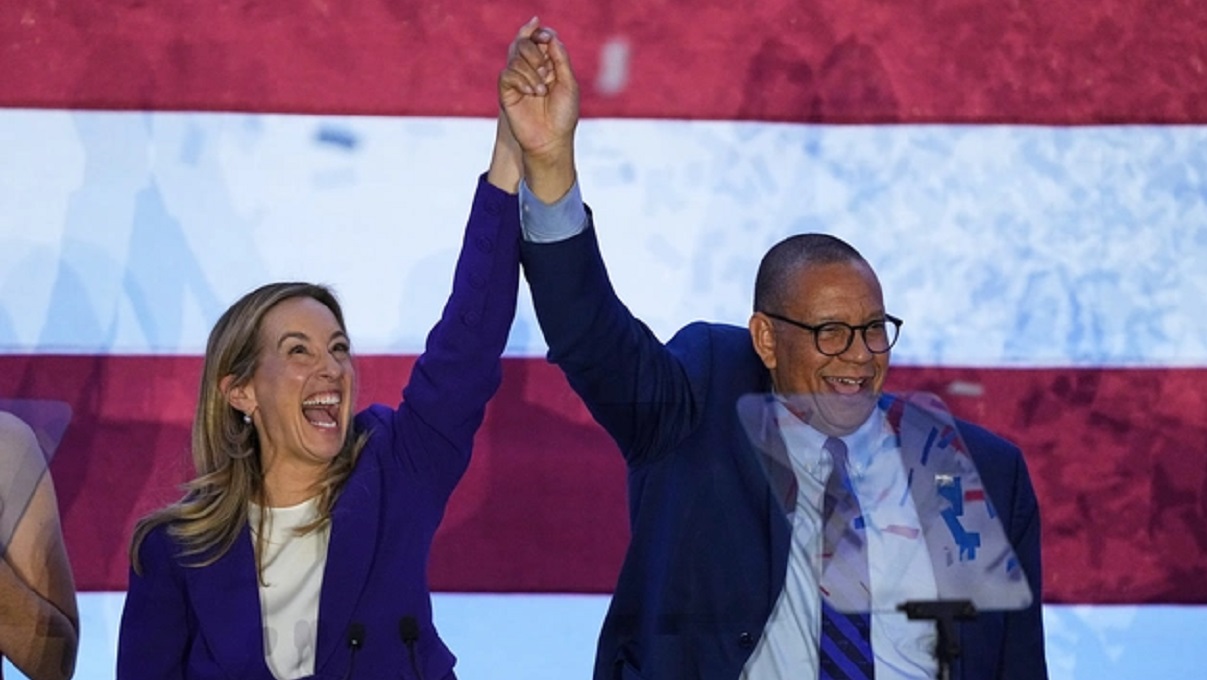
By James J Devine
Former New Jersey Lt. Gov. Dale Caldwell resigned from office Sept. 25 after an investigation substantiated allegations of sexual harassment and ethics violations, and he has since been suspended from his pastoral duties in the United Methodist Church.

The incident revealed serious shortcomings in the selection process of the a replacement for the most powerful governor in the nation, which denies both the people and their representatives any meaningful role.
Caldwell, 66, stepped down one day after Gov. Mikie Sherrill publicly called for his resignation and gave him until the following day to leave office. The 61-page report by the law firm Lowenstein Sandler, released Sept. 23, found Caldwell engaged in “serious, repeated violations of state policy,” including sexual harassment.
“This investigation was thorough and impartial,” Sherrill said in a statement. “The substantiated finding of sexual harassment is extremely troubling.”
The investigation also found Caldwell brought unpaid guests to ticketed events and tried to secure a promotion for a romantic partner.
Anonymous complaint launched probe
The inquiry began after an anonymous letter dated May 6 was sent to state officials and media representatives, accusing Caldwell of bringing “uninvited female guests” to events and distributing business cards to women he hoped to date.
The state’s chief ethics officer engaged Lowenstein Sandler in May to conduct the investigation. Sherrill’s office hired Christopher Porrino, a former state attorney general who served under Republican Gov. Chris Christie, to lead the inquiry.
Caldwell denied wrongdoing throughout, calling the allegations “inaccurate, misleading and completely false.” He said he never asked anyone out on a date or pursued anyone romantically while conducting official business.
Prior concerns documented before formal probe
The investigation report revealed that concerns about Caldwell’s conduct had reached senior administration officials months before the formal inquiry began. A senior official warned Caldwell on March 25 about what an adviser described as a “concerning pattern” in his approaches to women, and senior officials confronted him again on May 1.
Caldwell received at least five trainings, warnings or counseling interventions before the investigation began, including two direct warnings about his conduct toward women, according to the report.
An anonymous complaint submitted May 14 triggered the formal investigation. Caldwell was notified May 22 that he was the subject of an internal probe.
Ministry suspension
The United Methodist Church suspended Caldwell from pastoral duties after receiving a complaint based on the investigation’s findings.
“Because we hold clergy to a high standard, we take the allegations made in the report seriously,” Bishop Cynthia Moore-Koikoi said in a statement. “In order to protect the well-being of Rev. Caldwell, the congregation, and all those involved, Rev. Caldwell has been placed on suspension while the complaint is processed.”
Caldwell, a licensed local pastor, is barred from preaching or carrying out other pastoral duties at Covenant United Methodist Church in Plainfield, where he has served since 2021.
He told UM News he disputes what he calls “specious” allegations and is exploring legal options to clear his name.
“This was just a poorly done attempt to frame me,” Caldwell said. “I can’t as a human being, as a Methodist and as a Christian allow that to happen.”
Caldwell claims his church suspension is not a result of the state investigation, contradicting Moore-Koikoi, who said she received a complaint “following the publication of the report about the former Lt. Governor” and placed him on suspension based on “the concerns raised in the report.”
He specifically denies making a derogatory comment about “young sperm” that formed the basis of the sexual harassment claim. The report said a state trooper driving a car at the time could not hear the conversation, and Caldwell noted investigators did not interview the staffer’s friend who was the subject of his alleged romantic advance.
“This entire report is based on one person’s testimony with no corroboration,” he told UM News.
Caldwell cited daughter, distraction in resignation
Caldwell said he resigned for two reasons: to spare his 22-year-old daughter from stress and to avoid distracting Sherrill’s administration from its work.
“I joined this administration because I wanted to make a difference,” he said. “By focusing attention on me, it takes away from the government’s focus on helping those people who can’t pay their bills.”
The Sunday after his resignation, Caldwell preached a sermon at Covenant United Methodist Church titled “When Lies Become Weapons,” referencing the biblical account of Joseph, who was falsely accused and imprisoned.
Report raises questions about vetting
An investigative report published Oct. 9 by The New Jersey Democrat raised questions about why Sherrill’s team selected Caldwell as her running mate despite a career marked by problems at public entities where he served as a board leader.
The report detailed findings from federal and state investigators at the New Brunswick Housing Authority, the Educational Services Commission and the College Achieve Greater Asbury Park Charter School.
At the New Brunswick Housing Authority, where Caldwell served on the board sometimes as chairman, the U.S. Department of Housing and Urban Development’s inspector general labeled it a “troubled public housing agency” in 2017. Federal investigators questioned more than $1 million in costs and said 10 contracts totaling $800,439 were not competitively bid or the prices charged could not be shown as reasonable.
Caldwell served as president of the Educational Services Commission board for 23 years. New Jersey Comptroller Kevin Walsh issued a report finding the commission violated state law by never submitting its contracts for review or approval, with about 43 contracts valued at more than $900 million not submitted in 2021 and 2022 alone. The audit also found $14.6 million in contracts were awarded without competition.
Sherrill’s campaign spokesperson Sean Higgins praised Caldwell’s role at the commission in August 2025, telling the New Jersey Globe that the organization “was a lifeline for some of our most vulnerable students” and “was able to help save taxpayers millions of dollars.”
On Jan. 16, 2026, Walsh sent a letter ordering the commission not to extend current contracts or proceed with proposed new ones because it still failed to comply with state law. Four days later, Caldwell became lieutenant governor.
Caldwell was founding board chairman of College Achieve Greater Asbury Park Charter School. A preliminary report issued by Walsh days before he left office in January 2026 confirmed “press reports regarding financial mismanagement, illegal procurement practices, and a lack of transparency regarding the use of public funds.” The report confirmed nepotism, including hiring family members and approving payments to a company run by the executive director’s brother-in-law.
The New Jersey Democrat also reported that in September 2025, a Centenary University employee contacted a Sherrill campaign staffer to report a hostile work environment while Caldwell headed the school. The staffer, Leslie Bockol, agreed to a phone conversation but then skipped the call and blocked the whistleblower, according to messages obtained by the New Jersey Globe. Bockol ultimately went to work as Caldwell’s speechwriter.
Raj Parikh, counsel to the Sherrill campaign, told The New Jersey Democrat that no staffer was “directed or authorized to independently engage or block the individual” and that “any allegations provided to the campaign were reviewed and, if needed, followed up on promptly.” Sherrill later said the matter was determined to be administrative.
Nancy Erika Smith, a civil rights and employment lawyer, told The New Jersey Democrat that institutions often dismiss what women report about how men treat them.
“It’s unfortunately not unusual in our culture for all institutions to overlook, disparage, minimize, and completely dismiss what women say about how men treat them,” Smith said. “Whoever complained at Centenary University was not as important as Dale Caldwell.”
A Rutgers-Eagleton Institute poll found that 68 percent of 976 respondents believed Sherrill handled the Caldwell situation somewhat or very well.
Political fallout
Republican lawmakers had demanded Caldwell’s resignation before the investigation concluded, while Democrats largely urged due process.
Assembly Minority Leader John DiMaio and Senate Minority Leader Anthony Bucco said after the report’s release that its findings confirmed the seriousness of the allegations.
“It is deeply disappointing that today’s report has confirmed and substantiated the ethics complaints and harassment allegations against Lt. Gov. Caldwell,” Bucco said.
U.S. Sens. Cory Booker and Andy Kim, both Democrats, joined Sherrill in calling for Caldwell to step down after the report was released.
State Sen. Britnee Timberlake, D-East Orange, had defended Sherrill’s handling of the investigation before its completion, saying a fair process must protect both those who come forward and the accused.
Assemblywoman Katie Brennan, D-Jersey City, plans to introduce legislation strengthening protections for survivors and whistleblowers.
“Anyone who uses the power of public office to mistreat the people around them has no business holding it,” Brennan said.
Background
Caldwell was elected lieutenant governor alongside Sherrill in 2025 and also served as secretary of state. He was the first Black president of Centenary University in Hackettstown and is the son of the late Rev. Gil Caldwell, a civil rights leader who marched with the Rev. Martin Luther King Jr.
Sherrill plans to name a new lieutenant governor within 45 days of Caldwell’s resignation. She has named an acting secretary of state.
—
A flawed process for filling the state’s second-highest office
The vacancy created by Caldwell’s resignation has exposed a fundamental flaw in how New Jersey fills its lieutenant governorship: when the office becomes vacant, the governor alone selects a replacement, with no requirement for legislative confirmation and no vote of the people.
Under the state Constitution, the governor has 45 days to appoint a replacement to serve the remainder of the term. The only qualifications are the same basic eligibility requirements as the governor: at least 30 years old, a U.S. citizen for at least 20 years and a New Jersey resident for seven years.
Assembly Republican Leader John DiMaio has proposed a constitutional amendment requiring any nominee to win approval from a majority of both houses of the Legislature before taking office. The proposal would model New Jersey’s process on the 25th Amendment to the U.S. Constitution.
“If the president of the United States cannot unilaterally choose a new vice president, why should a New Jersey governor have unilateral authority to choose the person next in line to become governor?” DiMaio said.
The current system allows a governor to install a replacement who has never faced a confirmation hearing or a public vote. This is particularly significant because the lieutenant governor is one heartbeat away from the governorship and, under the current arrangement, also serves as secretary of state—the state’s chief election official.
Until a new lieutenant governor is installed, Senate President Nicholas Scutari serves as acting governor whenever Sherrill is outside New Jersey or otherwise unable to perform her duties. The Assembly speaker would be next in the line of succession.
This temporary arrangement recalls the pre-2006 system, when the Senate president was first in the line of succession and served as acting governor when an incumbent left the state—a system that raised separation-of-powers concerns because a single individual exercised the powers of two branches of government.
The irony is striking: New Jersey created the lieutenant governor’s office in 2005 partly to resolve those very concerns and to ensure that the immediate successor to the governor would be someone within the executive branch, chosen by the entire electorate. Yet when that office becomes vacant, the replacement is chosen by one person alone, with no public input and no legislative check.
If the office is important enough to be elected by more than 6 million New Jerseyans, as DiMaio noted, the process for filling a vacancy should reflect that significance. The current arrangement—governor’s sole discretion, no confirmation, no vote—falls short of that standard.


Leave a Reply