

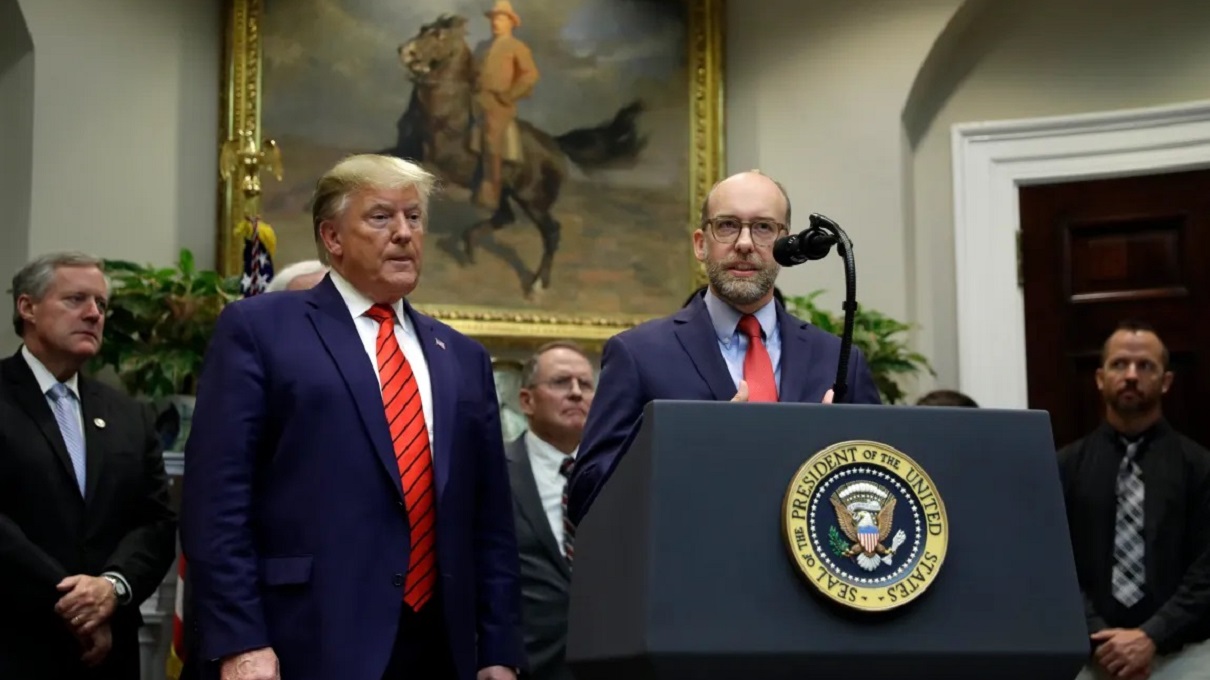
For those who have wondered how a dummy like President Donald Trump can get anything done, when he clearly lacks any degree of comprehension about the complexities of government—or anything that cannot be summed up in a three-word chant—a Republican Rasputin is exerting a hidden, manipulative influence over the tyrannical former game show host.
ProPublica is calling Russell Vought, the director of the White House Office of Management and Budget, the “shadow president” — a low-profile bureaucrat who has quietly become the architect of the second Trump administration’s most consequential moves, directing policy and spending that Trump may not fully understand.
In an investigation published Friday and co-published with The New Yorker, ProPublica reporter Andy Kroll describes Vought as a bookish technocrat with an encyclopedic knowledge of government who has centralized decision-making power to an extent that senior officials say they feel like “he is the commander in chief.”
“We work for the president of the United States,” a senior agency official told ProPublica. “But right now it feels like we work for Russ Vought.”
The investigation, based on internal documents, court records, and secret recordings of Vought’s private speeches, portrays a man who has spent his career preparing for this moment.
Vought chaired the transition portion of Project 2025, the conservative blueprint that Democrats vilified during the 2024 campaign and that Trump publicly disavowed. Vought helped draft some 350 executive orders, regulations, and other plans to expand presidential power.
“Despite his best thinking and the aggressive things they tried in Trump One, nothing really stuck,” a former OMB branch chief told ProPublica. “Most administrations don’t get a four-year pause or have the chance to think about ‘Why isn’t this working?’ Now he gets to come back and steamroll everyone.”
‘Trauma Achieved’
The investigation reveals Vought’s approach through secretly recorded speeches he gave to allies and donors during the Biden years. In one 2023 speech, Vought described his strategy with chilling directness.
“We want the bureaucrats to be traumatically affected,” Vought said. “When they wake up in the morning, we want them to not want to go to work, because they are increasingly viewed as the villains. We want their funding to be shut down so that the EPA can’t do all of the rules against our energy industry because they have no bandwidth financially to do so. We want to put them in trauma.”
The quote became a rallying cry inside the administration. After Vought announced mass firings across the federal government in October, an official texted ProPublica: “Trauma achieved.”
Vought has frozen or canceled more than $410 billion in congressionally approved funding, according to Democrats on the House Appropriations Committee. The cuts have touched everything from clean energy subsidies and Head Start programs to PEPFAR, the AIDS prevention initiative created under President George W. Bush, and grants for medical research at the National Institutes of Health.
At a February meeting about foreign aid, Vought asked his staff what would happen if they cut humanitarian assistance far more deeply than the 50% reduction they had proposed. When a career official said more people would die, Vought replied, “You could say that about any of these cuts.” A person familiar with the meeting described his reaction as “blasé.”
“It was the day that broke me,” another person told ProPublica.
‘Woke and Weaponized’
The investigation details how Vought deliberately crafted the phrase “woke and weaponized” as a political tool to justify defunding agencies and programs.
“When you hear the words ‘woke and weaponized’ come out of an elected official’s mouth, you can know that that came from us,” Vought said in one recording.
The strategy has been embraced by Republicans across Washington. Sen. John Barrasso of Wyoming, Rep. Matt Gaetz of Florida, Rep. Lauren Boebert of Colorado and others have used the phrase to attack federal agencies.
Vought accused the Department of Veterans Affairs of being captured by “woke-ism.” He labeled the Gateway infrastructure project in the Northeast as infiltrated by diversity, equity and inclusion efforts. The label became a justification for freezing funds.
“It’s a way to dress up spending cuts that aren’t popular on their own merits,” Jessica Riedl, a budget expert at the conservative Manhattan Institute, told ProPublica.
The Unitary Executive
At the core of Vought’s agenda is an expansive theory of presidential power that most legal scholars reject as unconstitutional. Vought argues that the president has the authority to withhold funds Congress has appropriated — a power known as impoundment that was explicitly outlawed by the Impoundment Control Act of 1974 following abuses by President Richard Nixon.
“The president has no authority to not spend money Congress has appropriated — that’s not a debate,” Steve Vladeck, a law professor at Georgetown, told ProPublica. “The president has no authority to fire civil servants who are protected by statute — that’s not a debate. We are seeing exertions of executive power the likes of which we have never seen in this country.”
Vought’s efforts have been aided by the Department of Government Efficiency, the Elon Musk-led initiative that ProPublica reports was guided more by Vought’s office than previously known. When DOGE took aim at obscure quasi-government nonprofits, OMB veterans saw Vought’s influence.
“I can’t imagine that the DOGE team knew to target all these little parts of the government without Russ pointing them there,” the former OMB branch chief said.
An administration official who worked with both men said DOGE showed Vought it was possible to ignore legal challenges. “He has the benefit of Elon softening everyone up,” the official said. “Elon terrified the shit out of people. He broke the status quo.”
Dismantling the Consumer Bureau
One of Vought’s most aggressive moves came at the Consumer Financial Protection Bureau, the watchdog agency created after the 2008 financial crisis. On Feb. 7, Trump named Vought acting director of the CFPB on top of his OMB duties. That morning, DOGE staffers arrived at CFPB headquarters and, according to emails and depositions, took orders from Vought as they disabled the agency’s website and decided which employees to fire.
Vought barred employees from doing most types of work and told them to “stand down from performing any work task.” He stopped oversight activities, quashed investigations and froze enforcement cases involving the nation’s largest banks. Then he announced a plan to lay off more than 80% of the bureau’s employees.
It took Vought four months to accomplish what the previous Trump administration had been unable to do in four years.
‘North of 10,000’ Firings
The government shutdown that began in October has become a showcase for Vought’s expansive theory of executive power. Trump posted on Truth Social that he would meet with Vought to decide which “Democrat Agencies” to cut. The OMB released a memo claiming furloughed federal employees were not guaranteed back pay — seemingly in defiance of a 2019 law. Then Vought announced that his campaign of mass firings had begun.
More than 4,000 employees have been laid off, disrupting cybersecurity efforts, special education programs, substance abuse treatment and small business loans. A federal judge issued a temporary stop, but Vought predicted the total would be “north of 10,000.”
Vought’s actions have drawn criticism even from some Republicans. Rep. Don Bacon of Nebraska described the chaos created when the Education Department told states that congressionally approved funding for after-school programs would not arrive.
“When something’s been appropriated, signed into law, and people are writing contracts based on the commitment of the federal government, and then they don’t know if they’re going to get it or not, it creates such chaos,” Bacon said. “I’m not sure what the OMB director thought he was doing.”
A ‘Radical Constitutionalist’
Vought, 49, has spent his entire adult life in Washington. Raised in Trumbull, Connecticut, by a Marine electrician and a schoolteacher, he attended Wheaton College, the “evangelical Harvard,” then climbed the Republican ranks working for Sen. Phil Gramm of Texas and later Vice President Mike Pence.
He describes himself as a “Christian nationalist” and says American democracy has been hijacked by rogue judges and a permanent class of bureaucrats. The central struggle of our time, he says, pits defenders of a “post-constitutional” order — what he calls the “cartel” or the “regime” — against “radical constitutionalists” fighting to destroy the deep state and return power to the presidency.
“The stark reality in America is that we are in the late stages of a complete Marxist takeover of the country,” Vought said in a 2024 speech, “in which our adversaries already hold the weapons of the government apparatus. And they have aimed it at us.”
In the recordings, Vought invoked the biblical story of Esther, who risked her life to save the Jews of Persia. He described the four-year pause between Trump’s terms as a divinely ordained opportunity to prepare.
“You know how the story ends,” Vought said. “Esther is not naive. She knew the risks. She knew her very life was at stake, but she acted anyway. If I perish, I perish. If they crush me with legal bills, they crush me with legal bills. If the FBI shows up at my door, it shows up at my door. If I end up in jail, I end up in jail. If I’m slandered, I’m slandered. If I’m ostracized, I’m ostracized, but I will do my duty, and then God can take care of the results.”
A Patronage System
Looking ahead, ProPublica reports that Vought is poised to expand presidential control over the more than $1 trillion in federal grants that flow to states, counties, cities and tribal governments each year for roads, water treatment, disaster response, health initiatives and schools.
Historically, that money has been distributed through a theoretically nonpartisan process with experts reviewing applications. Vought has proposed replacing that system with one run overwhelmingly by political appointees loyal to the administration, giving the federal government more power to cut off grants to recipients seen as out of line with the White House.
One expert described it to ProPublica as a plan to create “a massive patronage system, where it’s all about political loyalties and relationships as opposed to the merits, as opposed to the science, as opposed to the tangible benefits to the people.”
Kroll said he believes Vought’s ultimate goal is to secure Supreme Court rulings that reorient how the American system of government works — establishing that the president can direct the Justice Department, the IRS and the Federal Reserve.
“He is deconstructing the government,” Kroll said. “He’s thinking for the long term.”


Leave a Reply