

By James J. Devine
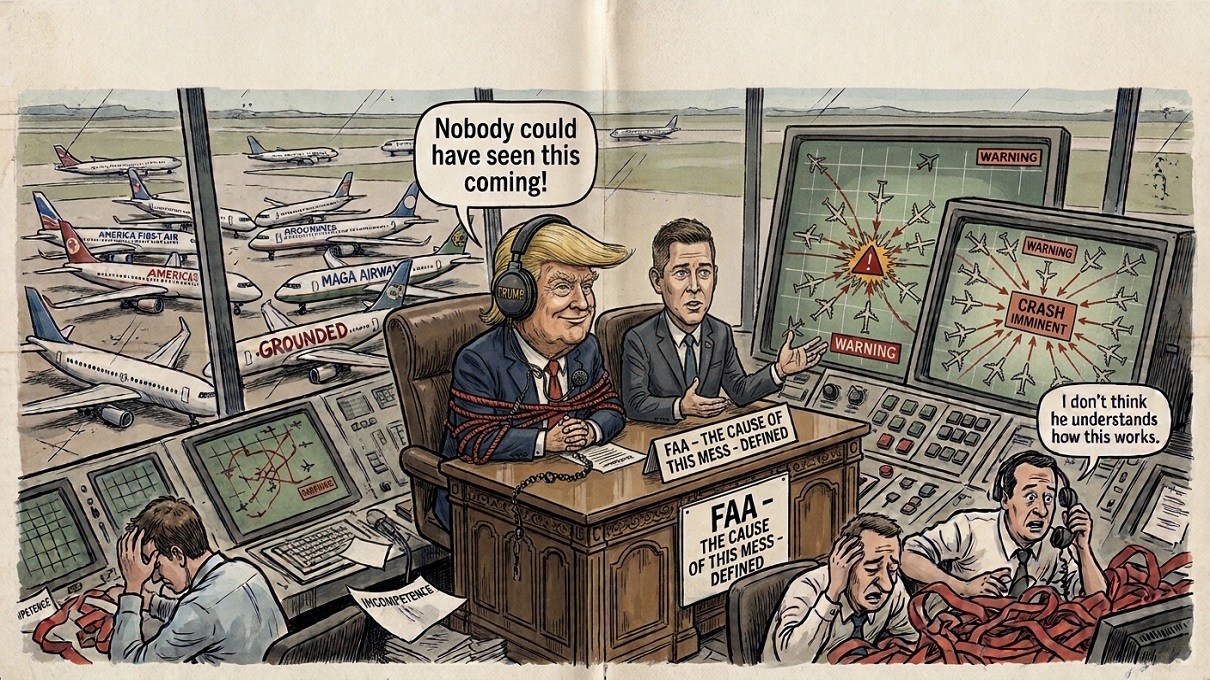
Nobody could have seen this coming.

Except the investigators. The controllers. The maintenance specialists. The government auditors. The passengers stranded during previous outages. And anyone who understood that repeatedly losing essential communications in an air traffic control system constitutes a warning.
On Nov. 13, 2026, the Trump administration’s Federal Aviation Administration halted departures nationwide after a communications failure affected air traffic control centers across the country. The agency invoked “extraordinary circumstances and for reasons of safety.” Transportation Secretary Sean Duffy said technicians were investigating.
An extraordinary circumstance, apparently, is what an ordinary infrastructure problem becomes after it acquires a national audience.
The event marked only the third nationwide ground stop in U.S. history, following the complete airspace shutdown after the Sept. 11, 2001, terrorist attacks and the January 2023 failure of the system that supplies essential notices to pilots. Unlike the 9/11 shutdown, Friday’s order did not require airborne aircraft to land immediately. Flights already in the air generally could continue to their destinations; departing aircraft remained grounded.
That distinction matters. So does another: Ordering a ground stop when essential communications are compromised is a responsible safety decision. Allowing the country to remain vulnerable to recurring failures is the management problem that deserves examination.
“The FAA issued a nationwide ground stop for all U.S. airports following a communication issue impacting all Air Route Traffic Control Centers. FAA technicians are investigating the issue. We will provide immediate updates as we have them,” Transportation Secretary Sean Duffy said.
The disruption is the latest sign of strain on the US air traffic control system, which has been beset by equipment failures, communications problems and shortages of controllers while the FAA tries to replace aging infrastructure.
Congress approved $12.5 billion for the overhaul last year, and the FAA and White House asked lawmakers on Friday for another $30.1 billion.
The Trump administration’s handling of aviation crises has raised questions about its priorities and competence.
Following the January 2025 collision over the Potomac River that killed 67 people, President Donald Trump blamed diversity initiatives without evidence before investigators released findings identifying longstanding institutional failures in airspace design and risk management.
In February 2025, the administration dismissed nearly 400 Federal Aviation Administration employees. Transportation Secretary Sean Duffy maintained that critical safety personnel were protected, but union representatives said the dismissals included maintenance mechanics at 18 facilities.
Throughout 2025 and 2026, aviation operations endured repeated communications outages affecting hubs such as Newark, a shortage of roughly 3,000 air traffic controllers, and the strain of requiring controllers to work without pay during the 2025 government shutdown.
The shutdown prompted flight reductions at 40 major airports.
The administration also promoted modernization initiatives while questions persisted about their execution.
Despite Government Accountability Office warnings about the need for stronger cost and schedule planning, the FAA announced the nationwide expansion of its SMART traffic-planning platform just three days before the Nov. 13 departure halt.
That timing does not establish that SMART caused the communications failure, but it is a glaring question that deserves a clear and honest answer.
To be fair, there were underlying vulnerabilities that preceded Trump’s return to office.
A major failure of the pilot notification system prompted a nationwide ground stop under President Joe Biden in January 2023. By September 2024, GAO had reported that more than three-quarters of the FAA’s air traffic control systems were unsustainable or potentially unsustainable.
Congress and previous administrations share responsibility for the deterioration.
The Trump administration secured $12.5 billion in modernization funding and requested roughly $30 billion more to complete the overhaul. Those investments represent substantial commitments, although their effectiveness depends on successful implementation.
The Nov. 13 ground stop might sound like a responsible precaution in response to compromised communications, but Americans are concerned that the Republican administration has not acted effectively to address known vulnerabilities before they produce a crisis.


Leave a Reply