

Second in a six-part series. Read Part I.
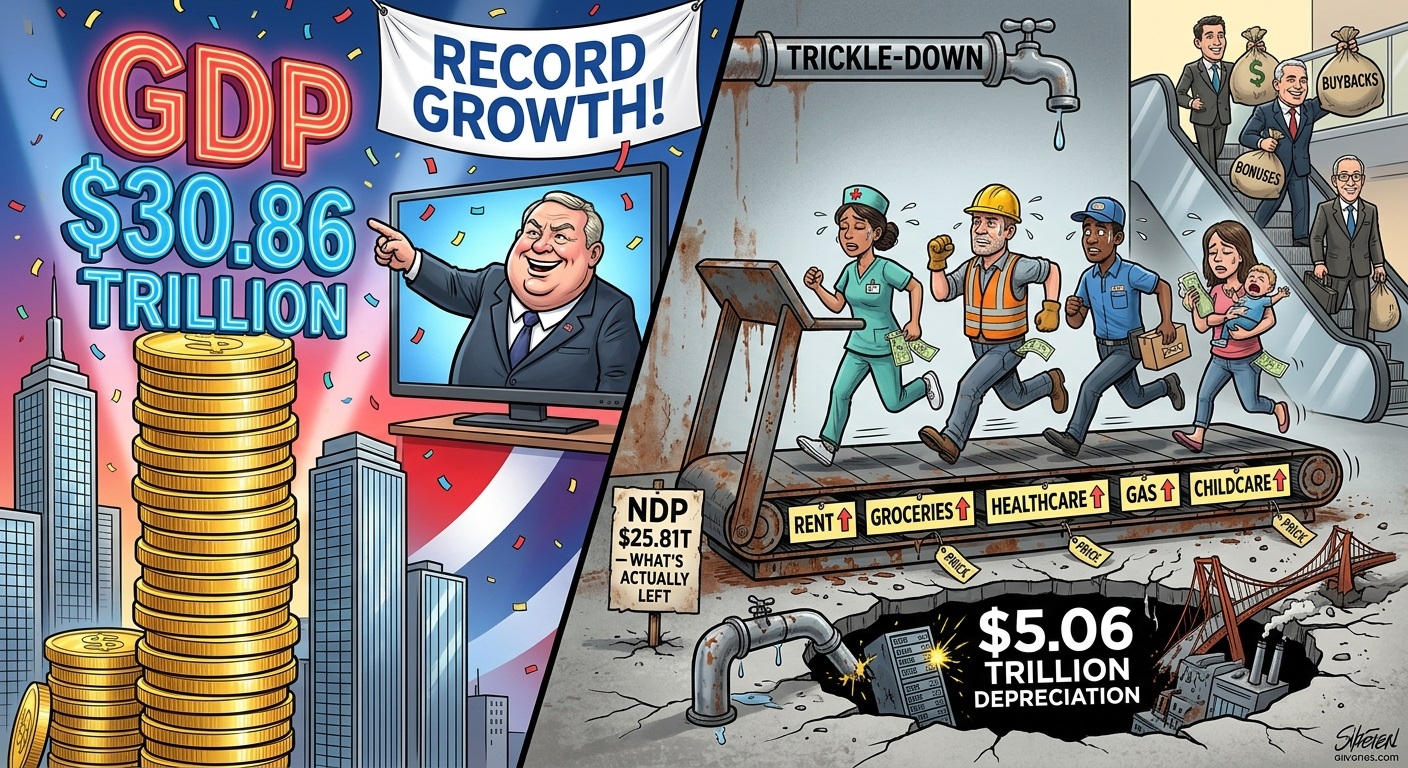
The number is Net Domestic Product. It starts with GDP and subtracts what the Bureau of Economic Analysis calls consumption of fixed capital: the machines worn out, the software retired, the buildings and roads ground down in the act of producing everything else. What remains is the output a nation can actually spend without eating into the base that makes next year possible.
In 1980, the last year before Ronald Reagan took office, that subtraction came to $428 billion. In 2025 it came to $5.06 trillion.
| Measure (current dollars) | 1980 | 2025 |
|---|---|---|
| Gross Domestic Product | $2.86 trillion | $30.86 trillion |
| Consumption of fixed capital | $428 billion | $5.06 trillion |
| Net Domestic Product (GDP minus depreciation) | $2.43 trillion | $25.81 trillion |
Say it plainly. Of the $30.86 trillion the country produced last year, $5.06 trillion did not raise anyone’s living standard, fund a new enterprise, or build anything that was not already there. It paid to replace what the year itself used up. That is one dollar in six, spent running to stay in place.
Depreciation is not a scandal in itself. Every economy wears out its tools. The scandal is the direction of travel. Supply-side policy promised that liberated capital would pour into durable, compounding investment. If it had, the economy’s net additions to its productive base would have grown faster than its gross churn. The record shows the opposite.
Next: Part III, Running in Place.


Leave a Reply