

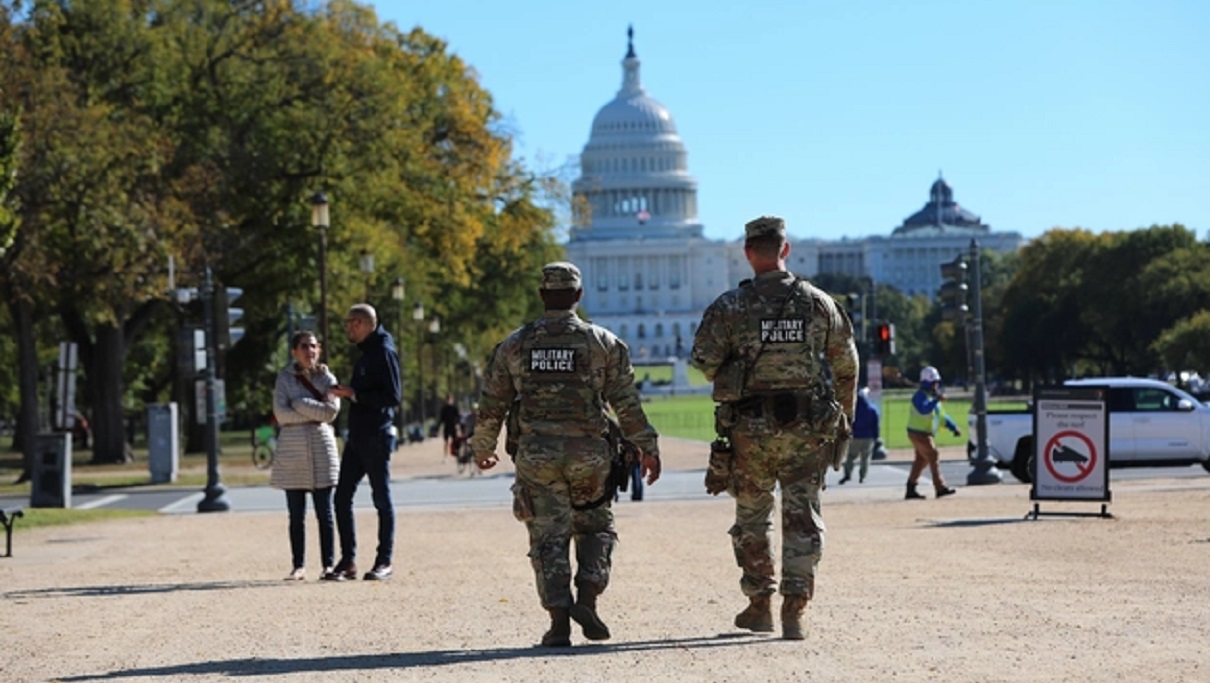
In a display of executive power that would make a king blush, the Defense Secretary has announced that, despite a court ruling that his military occupation of the District of Columbia is illegal, the President has ordered another 500 troops into the nation’s capital, from the sun-drenched remove of his Mar-a-Lago estate.
This command hurtles past a federal judge’s ruling like a bullet past the Constitution, landing in a city still rattled by a targeted shooting that left two Guardsmen bleeding on a downtown corner.
The President’s resolve, we are told, has been stiffened. Instead of obeying the court order, the administration is acting as if it’s a petty annoyance to be ignored or brushed aside.
The spectacle is as precise as it is grotesque.
While the District of Columbia successfully argued in court that this ongoing military occupation violates no less than five separate acts of law and the Constitution itself, the administration’s response is not to appeal to reason, but to double down on the delusion.
After U.S. District Judge Jia Cobb dissected the government’s legal arguments with the clinical precision of a surgeon, finding their interpretation of statute so broad it would “allow the President to ignore the receiving states’ voices entirely.”
She concluded, with a dryness that ought to be studied, “Such a reading cannot be right.”
Yet, here we are, living in the world of what cannot be right.
The Secretary of Defense now stands as the carnival barker for this tragic show, proclaiming a “historic” drop in crime as if the ends justify any means, no matter how lawless.
What he fails to trumpet with equal vigor is the historic collapse of local commerce, as restaurants wither and tourism flees a city that resembles a green-clad garrison more than a democratic capital.
The courts are so clogged with the administration’s cases that justice is now scheduled for 2027, a farcical delay that mocks the very concept of a speedy trial.
This is the “beauty” of their safe and beautiful mission: a hollowed-out city, its economy on life support and its court system in chains, all for a political photo opportunity.
One is left to wonder if the President, surrounded by the gilded tranquility of Florida, even hears the death rattle of local businesses or the frantic gavels in overwhelmed courtrooms.
From that distance, a soldier’s blood is just another token on the game board, a tragedy to be leveraged for more power, more troops, more theater.
The judicial branch has spoken. The legislative intent is clear. But in the face of a man who believes his will is law, facts are but whispers in a hurricane.
The Founders, in their wisdom, designed three branches of government to check one another’s ambitions.
They never accounted for one branch simply refusing to pick up the phone.
The legal battle for the soul of American governance is being waged not in a single, grand courtroom, but across a fractured landscape of judicial districts, a slow-moving civil war fought with injunctions and stay requests.
The map of the United States is now a checkerboard of conflicting rulings, a testament to an administration that treats the judiciary not as a coequal branch, but as a series of obstacles to be bypassed or bulldozed.
In the Seventh Circuit, which covers the American heartland, a measure of sanity prevails.
There, a panel of judges—including one appointed by Trump himself—unanimously refused to stay an order blocking the deployment in Illinois. They looked at the government’s claims of chaos and found them wanting, siding with a district judge who saw no evidence that federal law enforcement was “unable” to function.
This ruling stands as a bulwark, a declaration that the President’s power, while substantial, is not a magic wand to be waved at any inconvenient protest.
But fly west to the jurisdiction of the Ninth Circuit, and you enter a legal funhouse mirror.
There, two different panels, heavily stocked with Trump appointees, have frozen orders that blocked deployments in Los Angeles and Portland. Their reasoning would be comical if the stakes were not so dire.
In Portland, where recent protests have featured more inflatable frog costumes than insurrectionists, the majority justified the military’s presence by citing ancient history—violence from months prior—and a litany of the absurd, including protesters shining flashlights and “acting boisterously.”
They have accepted the administration’s alternate reality, where a handful of noisy citizens constitutes a rebellion that regular law enforcement cannot handle, ignoring the vast reservoir of 90,000 federal officers within the Department of Homeland Security itself.
This has created a nation of two legal systems.
A Guardsman in Chicago is a citizen in uniform, protected by a judge’s order. That same Guardsman in Portland is a federalized soldier, his presence upheld by a court that deferred to a President’s fantastical claims.
The dissenting judge in the Portland case, a moderate, issued a plea that was both stirring and despairing, warning that her colleagues were eroding core constitutional principles and asking the public to “retain faith in our judicial system for just a little longer.”
The endgame now hurtles toward a Supreme Court that has grown accustomed to the administration’s constant emergencies.
The Justice Department has its papers ready, seeking an emergency stay to force the troops into Illinois, hoping the nation’s highest court will bless the Ninth Circuit’s deference to executive fantasy over on-the-ground fact.
The fundamental American principle that the military is not a police force hangs in the balance.
If the Supreme Court agrees that a few flashlights and a noisy crowd render the President “unable to execute the laws,” then the last lock on this particular door will have been picked.
The soldier on your street corner will no longer be a crisis; he will be a precedent.


Leave a Reply