

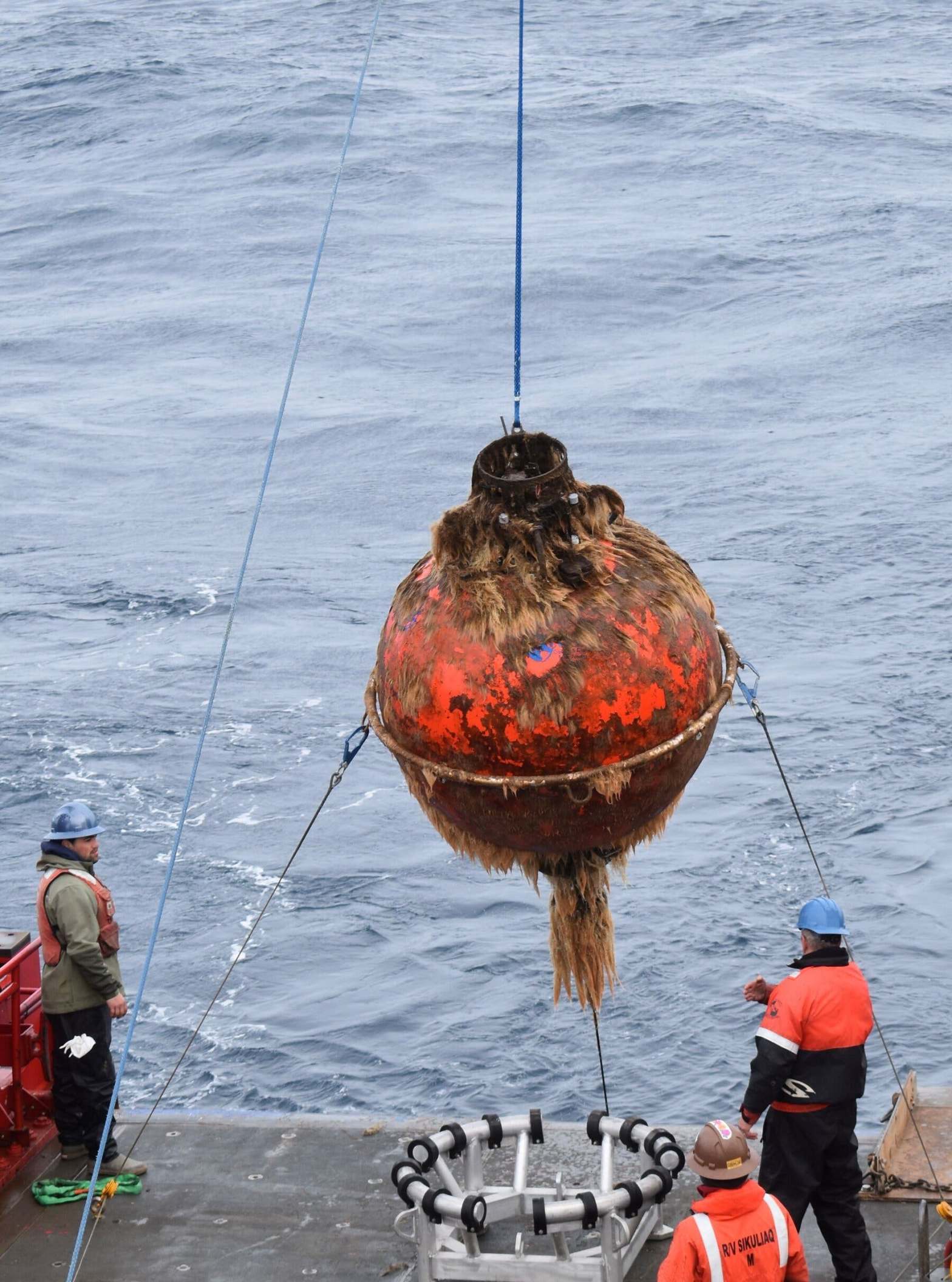
The Trump administration is scrapping the $368 million network of scientific eyes and ears at the bottom of the ocean with the kind of deliberate ignorance that would make a mule look like a philosopher.
The National Science Foundation says it will send ships in June to begin hauling up more than 900 deep‑sea instruments anchored off Oregon, Washington, Alaska, North Carolina, and the Irminger Sea between Greenland and Iceland.
This system was put in place a decade ago to monitor coastal environments, marine ecosystems, and the powerful ocean currents that drive the global climate.
Most people would recognize it as the real life version of devices depicted in The Day After Tomorrow, which gave scientists an early warning about the rapid ICE Age onset.
Scientists have used its data to track how the ocean absorbs greenhouse gases, to understand marine heat waves that devastate fisheries, and to predict coastal flooding along the East Coast.
In the Irminger Sea, the system has been essential to studying the Atlantic Meridional Overturning Circulation—that great conveyor belt of water that some scientists fear is weakening as the planet warms.
If that current collapses, the weather effects would be severe and far‑reaching. But do not let that trouble you.
The Trump administration has decided that all that knowledge is not worth keeping because it proves fossil fuel industry neglect and liability. Instead, Trump will force taxpayers to spend millions of dollars to permanently disconnect the system.
And here is the kicker: once those instruments come up, the network cannot be rapidly restored. The science denial is just lazy, since sea level rise is not something that can be swept under the rug.
Republican leaders concocted this devious plan after President Donald Trump explicitly asked oil company officials to fund a $1 billion component of his 2024 campaign.
That is not a rumor. That is a fact.
Observers have called the offer tantamount to bribery. And it is far from the only example of pay‑to‑play politics attached to this president. Trump accepted a $400 million airplane in exchange for security guarantees to Qatar. He took a $2 billion investment in his family‑owned cryptocurrency company from one of the hundreds of criminals he pardoned in his second term. The pattern is plain: if you pay the man, he will do your bidding. And the oil companies paid.
So now the American people are left in the dark about the harm caused by fossil fuel companies. The very data that could prove the damage and help coastal communities prepare for what is coming will be gone. The only thing the administration is preserving is the ignorance of its donors.
That is the news from Washington. The ocean is rising, the currents are slowing, and the people who are supposed to be watching are being told to pack up their gear and go home. You can draw your own conclusions about who benefits. They are not hard to find.
In 2025, a firm associated with the Abu Dhabi government purchased $2 billion worth of USD1 stablecoins from Trump’sWorld Liberty Financial and secretly bought a 49% stake in the company for half a billion dollars; shortly hereafter, the Trump administration approved a plan to give the UAE firm hundreds of thousands of advanced, scarce computer chips, despite national security concerns.
Legal experts described the UAE deal as a potential violation of the emoluments clause of the U.S. Constitution.
Binance founder Changpeng “CZ” Zhao was pardoned after pleading guilty to violating the U.S. Bank Secrecy Act’s anti-money laundering rules, after the the cryptocurrency billiinaire allegedly funneled roughly $2 billion into the Trump family’s cryptocurrency venture.


Leave a Reply