

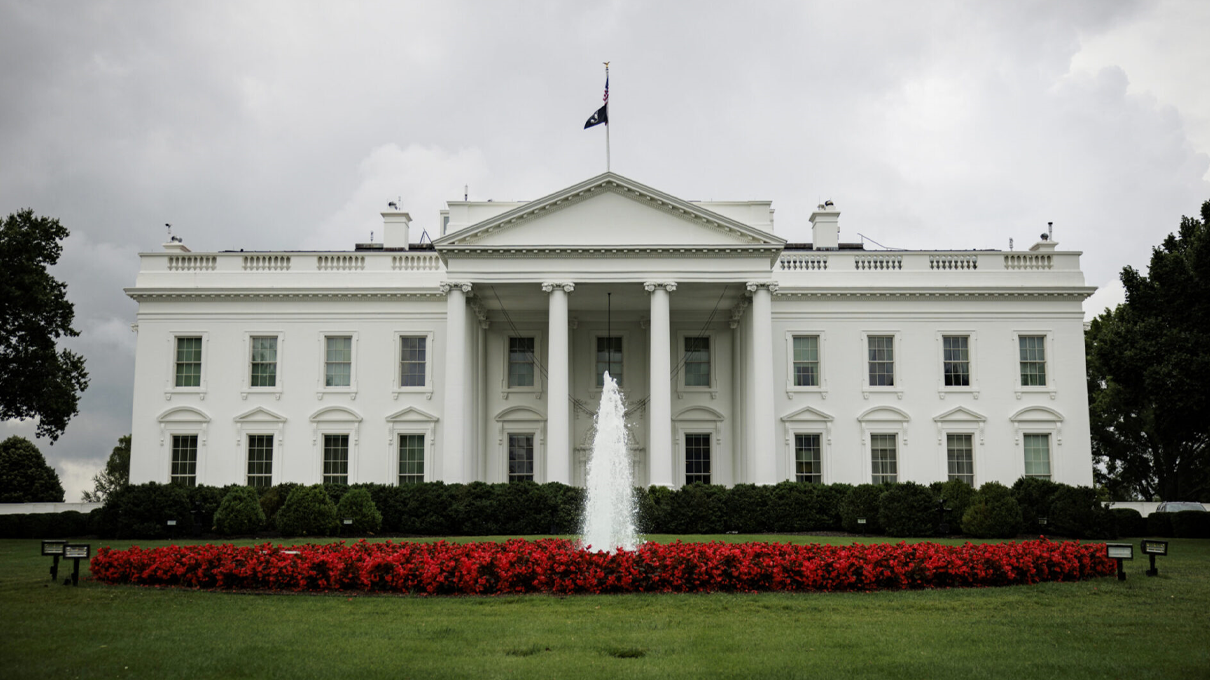
The White House has spent more than $1.7 million in taxpayer money on a series of television ads prominently featuring President Donald Trump, drawing sharp criticism from Republicans and Democrats alike who allege the spots amount to political propaganda ahead of the November midterm elections.
The White House defends them as patriotic public service announcements.
The ads, which carry the disclaimer “Paid for by the U.S. Government,” began airing in late September, just weeks before the midterm elections that look grim for Republicans as a result of Trump’s incompetence, ineptitude and corruption.
Ads closely mirror campaign messaging
The latest spot closely tracks a 2024 Trump presidential campaign ad. It shows Trump walking down a hallway as he asks people in a voiceover to join him in his “final battle” to “demolish the deep state” and “expel the warmongers from our government.”
An earlier ad features scenic footage of Mount Rushmore at night, along with clips from Trump’s Fourth of July weekend speech there honoring the country’s 250th anniversary.
“We know that this is not an ending,” Trump says in the ad. “This is only the beginning of the golden age of America.”
The ad ends with a message from Dana White, chief executive of the Ultimate Fighting Championship, proclaiming Trump “the toughest, most resilient person that I’ve ever met.”
The first ad, a 30-second spot, features clips of Trump talking about defeating communism, interspersed with on-screen text promoting the “largest tax cuts in history” and “reigniting American manufacturing.” Its soundtrack includes a chorus singing “love me” repeatedly.
Lawyers for JMSN, the R&B artist who wrote and recorded the song, sent a cease-and-desist letter to the White House on Monday demanding that it stop using his music.
AdImpact, a political ad-tracking firm, estimates the administration has spent more than $1.7 million to run the ads.
Funding source questioned
According to a letter from two Democratic senators to Homeland Security Secretary Markwayne Mullin, the Department of Homeland Security diverted $20 million from Trump’s signature “One Big Beautiful Bill” to pay for the ads — money originally intended for U.S. Customs and Border Protection.
Sen. Susan Collins, R-Maine, confirmed the funding source to reporters, saying “it was taken out of funding that was supposed to be for Customs and Border Protection.”
She noted that appropriations bills typically bar using money from one account for another purpose, “which is why the administration went around the appropriations process and used an account that was part of the reconciliation bill.”
Collins, who chairs the Senate Appropriations Committee, faces a difficult re-election bid this fall.
House Democrats said Office of Management and Budget Director Russ Vought transferred the money from DHS on Sept. 19 to pay for the ads.
Republicans break with Trump
Senate Majority Leader John Thune of South Dakota became the highest-ranking elected official to break with the Trump administration over the matter.
“It’s a great message. I like the message. But it shouldn’t be paid for with taxpayer dollars,” Thune told reporters Monday.
Sen. John Cornyn, R-Texas, who lost his primary to Trump-backed Attorney General Ken Paxton, told The Hill he does not agree with using taxpayer funds for the commercials.
“We all know you’re not supposed to use taxpayer money for that purpose,” he said.
Sen. John Kennedy, R-La., told CBS News’ “Face the Nation” on Sunday: “I don’t think any public official, including President Trump or Kristi Noem or John Kennedy, should spend public money on private ads for themselves.”
Sen. Thom Tillis, R-N.C., who announced his retirement last year after clashing with Trump over the megabill, tore into the president’s decision to fund the ads with taxpayer money.
“I hate it. I tell you, it feels like Viktor Orbán talking to the Hungarian people. There’s no place for that sort of thing,” Tillis said, adding that Trump could have used political resources if he wanted to run a political ad.
“If it were, you know, some clear message that was going to appeal to the broader, a real public service announcement, that’s fine,” Tillis said. “But that was not that.”
Rep. Thomas Massie, R-Ky., who has often spoken out against Trump, compared the advertisements to something seen in a banana republic.
“Don’t worry, using taxpayer dollars to run ominous campaign ads of the President has been done before and is completely legal … in banana republics,” he wrote on X.
Sen. Jim Justice, R-W.Va., who provided a key vote to pass the megabill, cast doubt on the wisdom of Trump’s decision when asked whether pulling the money from CBP was a good move.
“Well, if that’s exactly what happened, probably not,” Justice said, while adding that he was not an expert on the legality of the move. “But at the same time, I don’t know the particulars to say, well, that those dollars can be used that way, or they can’t be used that way. I don’t know. I just don’t know.”
“I can’t imagine how smart the people in the administration are that they’ve done something that’s just going to fly right in their face,” Justice said. “I can’t imagine that they’ve done something that they know is not right, not ethical, not whatever. I just couldn’t imagine they’d do that. They’re too smart for that.”
Former Rep. Justin Amash, who served in Congress as a Republican but has since left the party, wrote on X: “A taxpayer-funded propaganda TV spot. This is the most shameless administration of our lifetime.”
Conservative commentator Erick Erickson said the ads are “not a public good” and constitute a “waste of taxpayer dollars.”
Michael Steele, former chairman of the Republican National Committee, also condemned the ads.
“This is a political Ad produced by the Federal Government. It was paid for with your tax dollars. It is propaganda. This should never happen because it is illegal, unethical and politically tone deaf,” Steele wrote.
White House defends ads
A White House spokesperson responded to the criticism in a statement that said: “These public service announcements are about reminding Americans to love their country and understand what makes it worth defending, at home, at our borders, and abroad. The ad is educational and unapologetically patriotic. We should be proud of our country.”
The White House on Friday defended the spots as “very clearly not campaign ads,” saying Trump is not on the ballot and the ads do not include a call to action, but the president told supporters at his midterm GOP convention to “pretend I am on the ballot” despite the large number of Republicans who are trying to distance themselves from the unpopular tyrant.
The White House provided examples of previous administrations from both parties that bought network time for public service announcements, including the George W. Bush administration airing a campaign about a Medicare law and the Biden administration running one about COVID-19 vaccinations.
“Patriotism isn’t partisan. These public service announcements are unapologetically American, clearly disclosed, and aimed at the country — not a line on the ballot,” the White House said.
It did not answer an inquiry about which part of the government supplied the funds.
Legal and ethics experts say the difference between those past presidents used ads to inform citizens about specific, actionable government benefits or public health crises. In contrast, the 2026 spots featured broad ideological messaging—such as footage of Trump speaking about defeating “communism, socialism and Marxism”—without connecting viewers to a specific public program
Legal concerns raised
Margaret Dylus-Yukins, senior legal counsel for ethics at the nonpartisan Campaign Legal Center, said federal law prohibits taxpayer resources from being used to benefit a candidate, political party or public official.
“These ads almost entirely revolve around President Trump, who is not a candidate, but who has told voters to act as if he is on the ballot in November,” Dylus-Yukins said. “The latest ad is a complete republication of a 2024 Trump campaign ad, and the earlier ad echoes themes and messages that Republicans are pushing this election; neither has any apparent connection to any federal program or service.”
“We don’t know which agency paid to produce and place these ads,” she continued. “But it’s difficult to see what legitimate government purpose is served by spending taxpayer dollars on ads whose only apparent purpose is to promote the president and reinforce his political message weeks before an election.”
“At a minimum, this is an appalling abuse of taxpayer dollars, particularly when hundreds of millions of private dollars are already flowing into U.S. elections — and Trump has personally helped raise enormous sums from wealthy special interests for a super PAC devoted to advancing his political agenda.”
The advocacy group Public Citizen filed complaints with the Government Accountability Office and the Office of Special Counsel, alleging that the ads violate the prohibition on using government funds for publicity purposes under 5 U.S.C. § 3107 and the Hatch Act’s restrictions on political activity by White House staff.
The group noted that since the 1950s, annual appropriations bills have barred the use of taxpayer funds for “publicity or propaganda” purposes.
Sen. Maggie Hassan, D-N.H., ranking member of the Joint Economic Committee and a senior member of the Senate Homeland Security and Governmental Affairs Committee, sent a letter to White House Chief of Staff Susie Wiles demanding details about the commercials.
She asked how much the ads cost to produce and air, which federal agencies and individuals were involved, who provided the federal funds and for the names of any outside contractors used.
“The advertisement raises deep concerns about the Trump Administration’s use of taxpayer dollars and its compliance with federal laws that prohibit the use of appropriated funds for the promotion of a political party or candidate,” Hassan wrote.
Senate Minority Leader Chuck Schumer, D-N.Y., said Monday that only Trump would have “the audacity to force Americans not only to watch his propaganda, but to pay for it.”
Rep. Jamie Raskin of Maryland, the top Democrat on the House Judiciary Committee, said that if the White House used government dollars to pay for the ad, it could constitute a violation of federal law.
“It is blatantly unethical,” he wrote on X.
Rep. Ro Khanna, D-Calif., said Monday on CNN that the advertisements constitute ethics violations but added that the more Republicans put Trump on television, the “happier” he is.
“Go spend as much money as you want putting Donald Trump on TV,” Khanna said. “Please put him on TV all over America.”
Previous controversy
Earlier in Trump’s term, DHS used taxpayer money to run a series of ads featuring then-Secretary Kristi Noem encouraging immigrants living in the United States illegally to self-deport.
The campaign cost more than $220 million and drew scrutiny from members of Congress. Noem was fired in March.
Political context
The ads are airing as Trump’s approval ratings have slid amid concerns over the economy, cost of living and surging gas prices.
A survey from American Research Poll published last week found Trump’s lowest approval rating yet, with 29% of respondents giving him positive marks and 68% disapproving.
An Emerson College poll showed his net approval at minus 19
Broadcasters told to stop airing the ad
Public Citizen filed a complaint with the FCC, FTC, individual broadcasters urging media companies to immediately stop airing the ad.
Public Citizen also filed a second complaint with the U.S. Government Accountability Office (GAO) and the U.S. Office of Special Counsel (OSC) alleging that the new ad violates laws prohibiting the use of government resources for propaganda, the Hatch Act, and other related laws.
The ads, which are airing in two media markets containing key districts in the upcoming midterm elections, include a disclaimer: “Paid for by the U.S. government.”
Public Citizen previously submitted a complaint to GAO and OSC after the first Trump-promoting government-funded ad appeared on air last week.
“That the Trump administration not only failed to acknowledge and investigate last week’s illegal ad, but instead doubled down and released a second piece of taxpayer-funded political propaganda during the mass-viewing moment of Sunday football is appalling and alarming,” said Lisa Gilbert, co-president of Public Citizen. “These illegal ads should immediately be pulled from the air, and the White House’s many apparent violations of the law should be investigated.”
“This administration’s repeated and flagrant violations of the law, including the Hatch Act, are an affront to taxpayers and our democracy,” said Craig Holman, Ph.D., a government ethics expert with Public Citizen. “The FCC and other oversight agencies are charged with ensuring this type of abuse of taxpayer funds does not happen. But that system only works if they take action.”
The letter to broadcasters notes that they should refrain from airing advertisements that they know are otherwise illegal under the law, and that broadcasters must maintain a public file on any political ads they air. Failing to uphold this duty can result in broadcast license revocation.


Leave a Reply