

A major new study from Brown University reveals that roughly 44% of U.S. pre-K-12 schools are located within one mile of a known environmental hazard site, including Superfund sites, brownfields, and Toxics Release Inventory facilities.
The research, published in the Proceedings of the National Academy of Sciences, found that approximately 8% of schools (nearly 10,000 schools enrolling 3.36 million students) sit within a quarter-mile of these hazards.
This analysis of environmental data places New Jersey squarely in the middle of a national crisis, with many of the state’s schools near brownfield sites, using data from the New Jersey Brownfield Sites Inventory.
Yet the most telling figure in this inventory is not race—but the economic class disparities are stark.
The data shows that 71% of the students in schools near toxic sites qualify for free or reduced-price lunch, evidence that the burden of proximity to industrial contamination falls most heavily on those whose families can least afford to move.
New Jersey’s inventory of brownfield sites, when cross-referenced with school locations, reveals that 409 schools—nearly 29% of all schools in the state—are within one mile of a contaminated property.
One hundred seventy-seven New Jersey schools are within half a mile. And 64 schools, serving more than 40,000 New Jersey students, are within a quarter-mile of a site where the soil, groundwater, or both are known to contain lead, PCBs, arsenic, petroleum products, or other industrial toxins.
The closest schools are so near to these sites that the distinction between campus and contamination zone all but disappears.
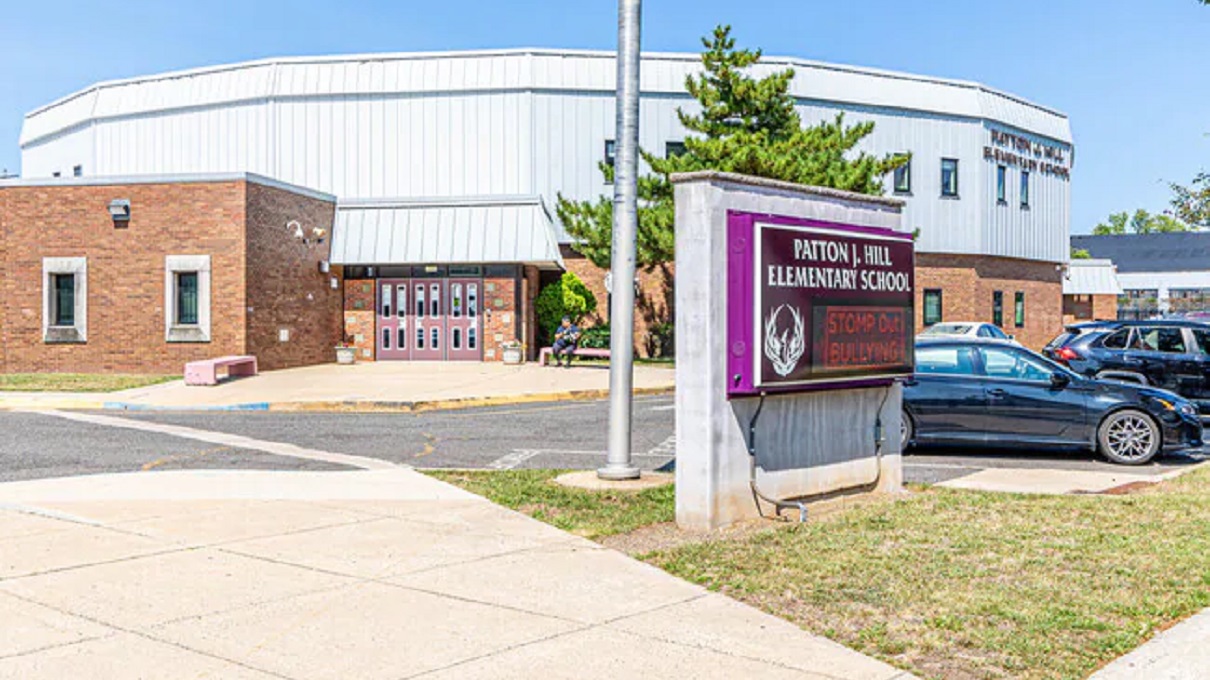
In Trenton, P.J. Hill Elementary School sits less than a tenth of a mile from the Thropp Site, a former industrial property where the state’s records indicate cleanup is necessary. Benjamin C. Gregory Elementary School is the same distance from the Anthony Storcella Property, a site contaminated with lead, PCBs, and other metals.
In Camden, Cooper’s Poynt Family School is less than a tenth of a mile from the Harrison Avenue Landfill, an 85-acre repository of lead, petroleum products, and volatile organic compounds.

In Jersey City, Liberty High School is 0.12 miles from Mill Creek, a contaminated waterway.
In Newark, Ann Street School is 0.18 miles from the Synfax landfill, where testing has found PCBs, SVOCs, and heavy metals.
The Brown study’s authors were blunt.
“It was shocking to us to discover how common it was for schools to be located near toxic sites and industrial pollution,” said Matthew Kraft, a professor of education and economics at Brown who coauthored the study. “This is something we need to be concerned about in nearly every community and across every state in the U.S.”
The researchers also documented what they called “deep inequities” in exposure.
Native American, Black, and Hispanic students are 124%, 86%, and 43% more likely, respectively, to attend schools within a quarter-mile of a hazardous site.
“Industrial operations often located their facilities in marginalized communities that have more limited political and economic power to oppose them,” the researchers wrote.
New Jersey’s data confirms the pattern.
In the 64 schools within a quarter-mile of a brownfield, 71% of students qualify for free or reduced-price lunch. Eighty-five percent are Black or Hispanic.
The schools are concentrated in the state’s largest cities—Newark, Jersey City, Trenton, Camden, Paterson, and Perth Amboy.
Urban schools face the greatest exposure nationally, with 12.7% within a quarter-mile of a hazard, compared with 6% in suburbs and 5% in rural areas.
The toxins found at these sites are not abstract threats.
Lead, arsenic, mercury, and PCBs have been linked to higher rates of childhood cancer, immune system disruption, birth defects, chronic illness, and cognitive impairment.
Children between the ages of 6 and 16 in New Jersey must attend school under state compulsory education laws. New Jersey ranks second in overall education according to U.S. News & World Report, but it has the sixth highest rate of new cancer cases per 100,000 people.
The Brown study noted that previous research has also associated proximity to such sites with poorer academic performance and a higher likelihood of students requiring special education services.
“Kids spend nearly a quarter of their waking hours at school,” the study’s authors wrote, “making school grounds a critical yet often overlooked source of environmental exposure.”
The pollutants originate outdoors, but they can infiltrate classrooms through windows and ventilation systems, and they affect children as they play outside or walk to and from school.
The state’s brownfield inventory includes sites at various stages of remediation. Some have been cleaned up. Many have not.
The Magic Marker site in Trenton, for example, sits less than a quarter-mile from multiple schools. The site is contaminated with lead, other metals, PAHs, PCBs, petroleum products, and volatile organic compounds. The state’s records indicate that contaminants have been found at actionable levels, and that cleanup is necessary.
The Second Street site in Perth Amboy—a former industrial property contaminated with lead, PCBs, and petroleum products—is within a quarter-mile of Anthony V. Ceres Elementary School, where more than 80% of students qualify for free or reduced-price lunch.

The Brown researchers said their findings should prompt targeted monitoring of air, soil, and water quality; expanded remediation efforts; modernization of school facilities; and more accurate communication of health risks to students, families, and staff.
“We’re hopeful the new descriptive evidence we compiled about the thousands of schools located within a few blocks of hazardous sites can help elevate this issue among policymakers and school leaders,” Kraft said.
In New Jersey, that evidence is a matter of public record. The schools and sites with environmental hazards are known, as are the consequences for the children from exposure to contaminants, so citizens should ask elected officials why something has not already been done.


Leave a Reply