

By JoAnne Castagna, Ed.D

The hot cup of coffee you sipped this morning was made possible in large part because of the scientific advances made during the Atomic Age in the 1940’s.
These innovations included the plastic parts on your coffee maker, the paper packets holding your sugar, the plumbing carrying your water, the microwave reheating your cup, and the electrical power running everything.
Society has benefited in so many ways from the work performed by Atomic Age innovators that included The Manhattan Project and the Atomic Energy Commission, predecessor of the U.S. Department of Energy, but unfortunately where this work was performed created waste that contaminated the land.
Soon, the U.S. Army Corps of Engineers, New York District will be cleaning up one of these properties and applying an innovative soil sorting system that will save tax-payer money, reduce air pollution, and most importantly return the land back to the community.
This property is the 37-acre Middlesex Municipal Landfill located in Middlesex, New Jersey that was contaminated by fill material brought there from the Middlesex Sampling Plant a mile away.
Middlesex Sampling Plant operated from the 1940’s to the1960’s and it’s where The Manhattan Project and the Atomic Energy Commission performed work.
During this time, these agencies were developing many innovations including advances in medical imaging and computing, as well as developments we use in our households today.
However, at the Middlesex Sampling Plant, they were focused on the creation of innovations to help with national security during World War II.
Performing this work required sampling, testing and processing radioactive uranium, some of which was dispersed over several acres of the Middlesex Sampling Plant property. At the time, the modern-day hazardous waste regulations that we have now did not exist.

Since then, the plant has closed and was successfully remediated or cleaned up and has been returned to the community that has plans to use it beneficially.
However, the landfill contamination is still being worked on. The landfill that’s been inactive for decades, was also remediated over the years that included removing approximately 31,650 cubic yards of radioactive contaminated soil.
After this, additional contamination was located, making the site eligible for the Formerly Utilized Sites Remedial Action Program that is responsible for remediating sites contaminated because of the nation’s early atomic energy program.
Since 1997, this program has been led by the Army Corps. So, the Army Corps was now in charge of remediating the property and carried out its own tests and confirmed that there is additional contaminated soil that needs to be removed.
The Army Corps is performing this work in collaboration with its partners that include the New Jersey Department of Environmental Protection, New Jersey Borough of Middlesex County, and the U.S. Department of Energy.
Starting in the early spring of 2027, the Army Corps will be performing additional remediation with the help of an innovative soil sorting system.
“Typically, when contaminated soil is excavated from a FUSRAP property, it’s transported and disposed of at designated disposal sites. Unfortunately, it’s difficult to separate radioactive soil from non-radioactive soil,” says Kathleen Cuzzolino, project manager, New York District, U.S. Army Corps of Engineers.
“This soil sorting process enables the project team to sort and separate the radioactive soil from the non-radioactive soil, so only the radioactive soil gets trucked away. Less material to be disposed of off-site means less trucks or railcars are needed to transport it and saves the project and taxpayers considerable money.”
How this Innovative Soil Sorting System Works
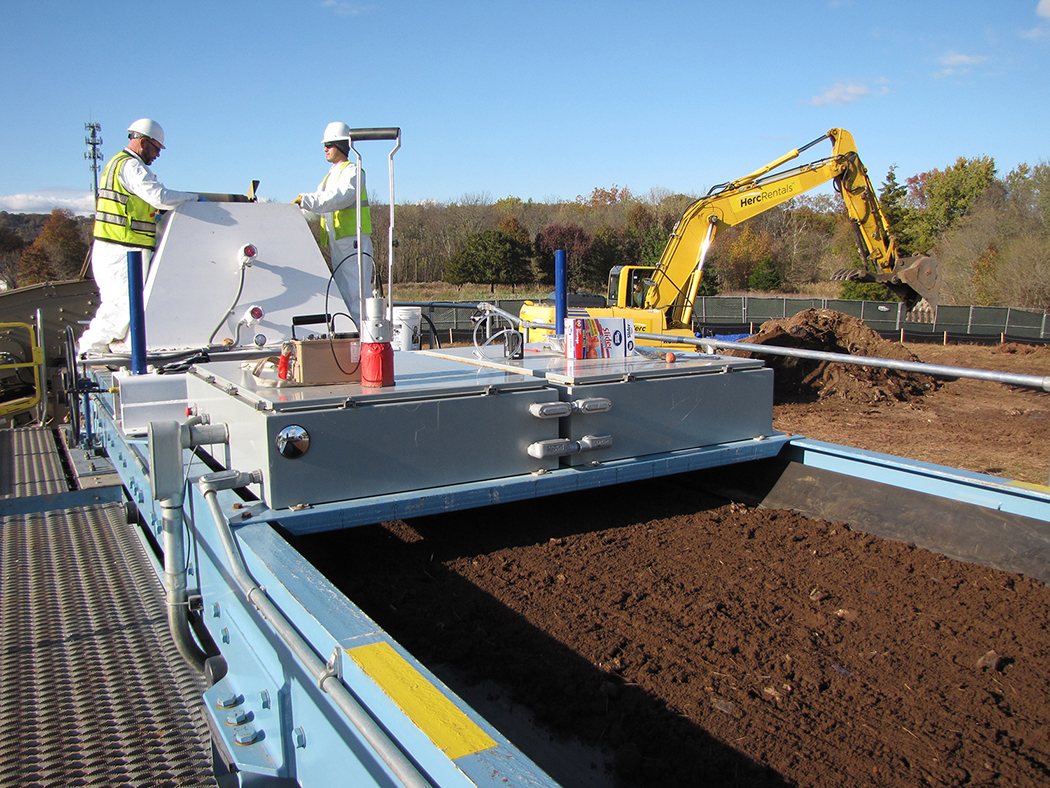
This system includes a stacker conveyor, surge bin, a wide main conveyor, sensory arrays, and a second auto-reversing conveyor.
Before excavated soil is processed using this system, it’s passed through a screen to remove large items such as concrete that would not easily fit under the sensor array.
Soil is then loaded, typically by stacker conveyor, into a surge bin, after which is flows out and is distributed evenly at a pre-determined depth across the six-foot-wide main conveyor.
The soil then passes under a sensor array. Different arrays are available to detect and sort a wide range of contaminants.
The radioactive and non-radioactive soil gets separated by a second auto-reversing conveyor at the end of the main conveyor that runs perpendicular to it.
The system has an onboard computer system that provides the project team with a summary report that shows the volume of material processed and diverted, among other types of information.
While the system is in use there are measures in place in the work area to monitor and protect the site workers and community from radiation.
After this process is completed, the radioactive soil is transported and disposed.
The largest cost for many remediation projects is often waste transportation and disposal. This soil sorting system may reduce the volume of site soils by approximately 60 to 75 percent, with only 25 to 40 percent of the original volume requiring off-site transport and disposal.
As a result, this saves money. Cuzzolino says, “This soil sorting system has been used successfully by other Army Corps Districts, and this project in particular should result in a 40 percent cost savings to taxpayers.”
She added that this system saves money in other ways. “This system also reduces health risks. Since less soil is being transported, there are less trucks and truck fumes, as well as less risk associated with transportation accidents.”
So, the next time you pour yourself a cup of coffee, you’ll know all the advances that were made to create the abundant world we have today, including the ones that are helping to protect it and save precious economic and environmental resources in the process.
Dr. JoAnne Castagna is a public affairs specialist and writer for the U.S. Army Corps of Engineers, New York District. She can be reached at joanne.castagna@usace.army.mil


Leave a Reply