

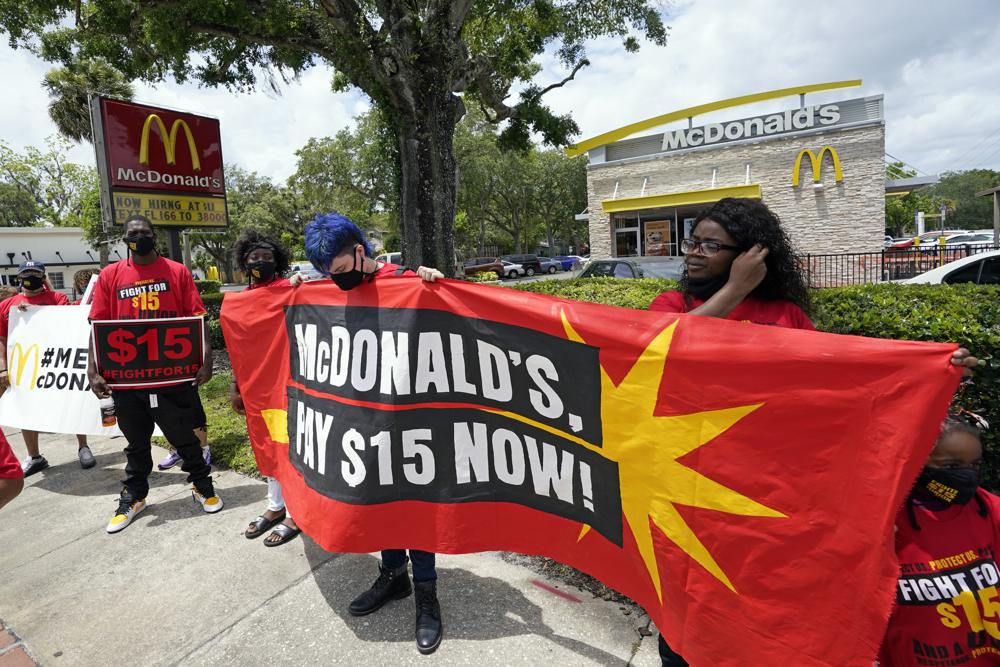
Most minimum-wage workers in New Jersey will see a pay increase at the start of 2027, but the state’s poorest workers and those who rely on tips will continue to earn far less than the newly announced standard.
The state Department of Labor and Workforce Development announced Tuesday that New Jersey’s minimum wage will rise to $16.48 an hour on Jan. 1, a 56-cent increase from the current $15.92 rate.
But the increases are not uniform.
Who Gets Less and Why
Agricultural workers will see their minimum wage rise to $15 an hour from $14.20, still more than $1 below the general rate. Under state law, farm workers are on a separate, slower schedule toward parity. The gap is rooted in a 2019 compromise that phased in increases for agricultural laborers more gradually than for other workers.

Tipped workers present a starker contrast. The minimum cash wage for employees who receive tips will rise to just $6.61 an hour from $6.05. Employers are legally required to make up the difference if tips plus the cash wage do not equal the full minimum wage, but workers’ advocates say enforcement gaps leave many tipped employees earning less than the standard in practice.
Seasonal workers and those employed by small businesses with fewer than six employees will see their rate rise to $16.25 an hour, slightly below the general minimum. Under the 2019 law, these workers are also on a delayed timetable, reaching full parity with the general rate by 2028.
Delaware and Pennsylvania
For comparison, Delaware’s minimum wage is $15 an hour. Pennsylvania’s remains at the federal minimum of $7.25 an hour, unchanged since 2009.
More than 30 states and the District of Columbia have set their own minimum wage levels higher than the federal baseline. Dozens of cities and counties enforce separate, higher local wage floors to adjust for the local cost of living.
The National Federation of Independent Business, which consistently opposes mandates to increase the minimum wage, endorsed three New Jersey Republican congressmen for re-election.

NFIB FedPAC, the business advocacy group’s federal political action committee, announced that Reps. Tom Kean, Jr. (R-Westfield), Jeff Van Drew (R-Dennis), and Chris Smith (R-Manchester) have aligned with the organization against minimum wage increases.
Congresswomen Delia Ramirez and Representative Analilia Mejia introduced the Living Wage for All Act to raise the federal minimum wage from $7.25 to $25 per hour.
“Housing, gas, and grocery costs have all surged, yet the federal minimum wage hasn’t been raised since 2009. This is unacceptable. No one working full time should be struggling to survive,” said Mejia. “We need an economy that reflects the realities of 2026, not one stuck over a decade ago.”
“This bill would transform millions of lives, ensuring working people earn a true living wage instead of being forced to choose between putting food on the table and taking care of their health. Americans deserve an economy that works for all, not just the billionaire class,” said Mejia.
The $25 per hour legislation is endorsed by the National Association for the Advancement of Colored People (NAACP), Service Employees International Union (SEIU), RWDSU, NEA, AFT, United Food and Commercial Workers Local 7, PolicyLink, One Fair Wage, Popular Democracy, Center for Law and Social Policy (CLASP), National Urban League (NUL), Southern Poverty Law Center (SPLC), Alliance for a Just Society, Black Women’s Roundtable, National Coalition for Black Civic Participation, Patriotic Millionaires, Our Revolution, Common Cause, and Voices for Progress (V4P).
It is also endorsed by the National Organization for Women (NOW), Chicago Education Advocacy Cooperative, ACLU of Hawai’i, Hawai‘i Public Health Institute, Trabajadores Unidos Workers United (CA), La Colmena NY, Community Labor United, Pennsylvania Policy Center, The New York Progressive Action Network, New Disabled South, Rights & Democracy Vermont, Survivors Know, The Able Baker, Churches United for Fair Housing (CUFFH), Keystone Progress Education Fund (PA), San Francisco Living Wage Coalition, Make the Road NV, Las Doñas, Construyamos Otro Acuerdo (Puerto Rico), La Tejedora (Puerto Rico), Fuck You I Quit, and a growing List of Small Businesses: Beauty by Teal, Elysium Aesthetics Lounge LLC, Conscious Life Resources, Undermine, Black Remote She LLC, SEPA Mujer, Inc.
The Legislative Pay Raise
The state minimum wage announcement comes as New Jersey’s 120 state legislators are earning an annual base salary of $82,000, a 67% increase from the $49,000 they had been paid since 2002. The raise took effect in January 2026.
The Legislature is classified as a part-time body. Most lawmakers hold outside employment. Supporters of the pay increase argued it was necessary to account for more than two decades of inflation and the out-of-pocket costs of holding office.
Critics called it an unfair burden on taxpayers, whose lowest legal full-time salary would only reach $34,278.40 or $13,748.80 for bussers, bartenders, and waitresses with the inflation-adjusted increase starting in January.
Campaign Contributions and the Law
New Jersey law draws a sharp line between campaign contributions and bribery. Contributions are regulated political donations subject to disclosure requirements and limits enforced by the New Jersey Election Law Enforcement Commission. Bribery is defined under N.J.S.A. 2C:27-2 as offering, conferring, soliciting or accepting “any benefit as consideration for” a public servant’s decision, vote or exercise of official discretion.
Prosecutors must prove a specific quid pro quo — a direct agreement to exchange something of value for an official act. Defense attorneys frequently argue that payments characterized by prosecutors as bribes were actually lawful campaign contributions, routine lobbying or attempts to build goodwill.
The difficulty of proving corrupt intent has been compounded by recent U.S. Supreme Court rulings. In Snyder v. United States, the court held that federal anti-corruption law prohibits bribes agreed to before an official act but does not criminalize post-payment gratuities — “tips” given to state and local officials after an action has already occurred. That leaves regulation of such after-the-fact rewards to local jurisdictions.
New Jersey lawmakers have introduced legislation to close some of those gaps. Assembly Bill A699 would expand the state’s bribery statute to cover candidates who have not yet assumed office, establishing that it is no defense that a person was not yet a public servant at the time of the prohibited act. The bill was introduced in January 2026 and remains pending.

Campaign Finance Overhaul
In April 2023, Gov. Phil Murphy signed the Elections Transparency Act, the state’s first major overhaul of campaign finance and pay-to-play laws in nearly two decades. The law doubled baseline contribution limits to $5,200 per election for candidate committees and raised annual contributions to legislative leadership committees to $75,000. It also preempted local pay-to-play ordinances with a unified state standard.
Public contractors contributed more than $18 million to New Jersey candidates and political committees in the 2025 elections — the first gubernatorial contest conducted under the relaxed rules — shattering a record set in 2007, according to an analysis by the Election Law Enforcement Commission. That figure was 87% higher than contractor contributions reported in 2022, the year before the law took effect.
The largest contractor donor was Uber Technologies, which contributed more than $1.1 million while reporting $8.5 million in public contracts. Eight of the ten largest contractor donors were engineering firms.
Critics, including some former ELEC commissioners, have argued the law weakens the agency’s independence and shortens the statute of limitations for enforcement actions from ten years to two.


Leave a Reply