

Days before another election, Americans are watching prices climb at the gas pump while the world’s largest oil companies count their winnings.
For working families, the energy crisis means another demand on a paycheck already stretched thin. For Big Oil, it means a spectacular quarter.
ExxonMobil reported $17.5 billion in adjusted quarterly earnings. Chevron reported $10.4 billion. Shell’s adjusted earnings reached $10.8 billion, nearly double the previous year’s figure. BP’s profit soared to $8.6 billion, nearly quadrupling from the same quarter of 2025, and TotalEnergies booked $9.1 billion in third-quarter adjusted net income, doubling earnings from a year earlier.
War and disrupted supplies have been punishing consumers and enriching producers.
The same crisis appears on opposite sides of their ledgers.
The companies are eager to explain the refining margins, but they are considerably shy when it comes to explaining the politics.
Their earnings announcements offer the familiar vocabulary of corporate success: production, efficiency, capital discipline, shareholder returns. What disappears behind that language is the relationship between the industry collecting the windfall and the government it spent lavishly to influence.
To investors, the message is: Look at this magnificent cash machine.
They are telling voters, “We just drill the holes.”
But an industry that bankrolls politicians and demands specific government favors cannot claim political innocence when the public gets the bill.
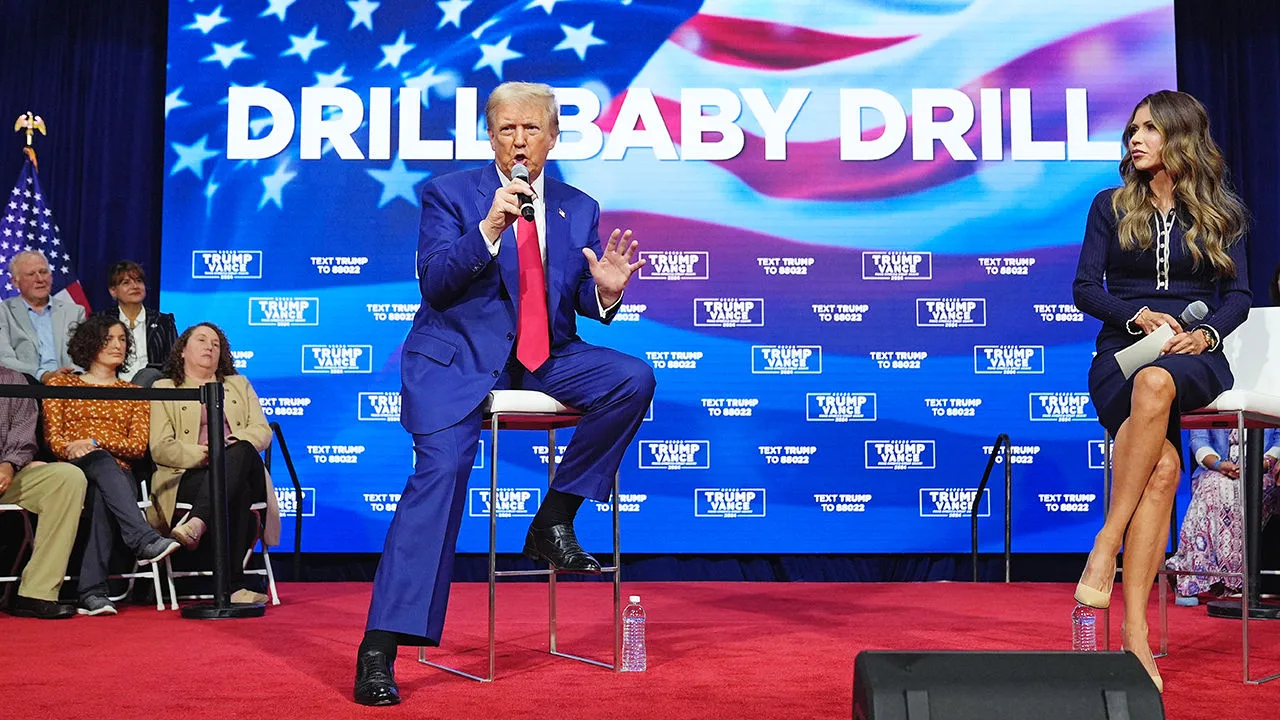
In April 2024, Donald Trump met with oil executives at Mar-a-Lago and reportedly asked them to raise $1 billion for his campaign.
In return, he offered policies the industry wanted: expanded drilling opportunities, an end to the pause on new liquefied natural gas export approvals, and the reversal of vehicle emissions rules. Congressional investigators subsequently pressed the companies for answers about the proposed exchange.
This was a presidential candidate putting a price on access to the machinery of government.

After Trump’s victory, fossil fuel companies contributed $11.8 million to his inaugural committee. Apparently, helping a president take office also requires helping pay for the celebration.
The industry’s investment was followed by hefty payoffs from an accommodating administration, detailed in a report from the Brennan Center for Justice.
Trump’s signature legislative package delivered roughly $18 billion in new and expanded oil and gas tax benefits, according to the Joint Committee on Taxation.
The Republican administration also moved aggressively to dismantle environmental protections and accelerate fossil fuel development.
Executive Actions and Structural Changes
- National Energy Emergency: Declared an energy emergency on Day 1 to bypass regulatory barriers and rapidly increase domestic oil, natural gas, and coal production.
- National Energy Dominance Council: Established a new federal council specifically dedicated to ramping up traditional energy extraction.
- Regulatory Freeze: Directed all federal agencies to pause new rulemakings and systematically review existing guidelines that burden domestic energy production.
Accelerating Fossil Fuel Development
- Alaskan Drilling: Lifted federal restrictions on energy production in Alaska, opening millions of acres of public land for expanded oil and gas exploration.
- LNG Export Approvals: Resumed the processing of export permits for new liquefied natural gas (LNG) projects, reversing previous restrictions.
- Drilling Permits: Significantly accelerated federal approvals, resulting in a 55% increase in drilling permits issued by the Bureau of Land Management.
Dismantling Environmental Safeguards
- Methane Rule Rollbacks: Proposed sweeping rollbacks under the Clean Air Act to weaken 2024 standards that required oil and gas operators to limit methane leaks and routine flaring.
- Power Plant Emissions: Repealed federal emissions standards for new and existing fossil fuel-fired power plants while targeting the legal basis of carbon regulations.
- Vehicle Efficiency Standards: Gutted Corporate Average Fuel Economy (CAFE) standards and vehicle tailpipe emissions rules.
Halting Clean Energy Initiatives
- Tax Credit Repeals: Signed legislation to dismantle clean electricity, fuel, and electric vehicle tax credits previously established under the Inflation Reduction Act.
- Renewable Energy Moratoriums: Implemented an offshore wind moratorium and placed temporary holds on processing new wind and solar permits on federal lands.
- EV Infrastructure Cuts: Froze approximately $3 billion in federal funding earmarked for national electric vehicle charging networks.
International Climate Shifts
Climate Finance Defunding: Revoked the U.S. International Climate Finance Plan, halting monetary commitments to international bodies assisting developing nations with climate transitions.
Paris Accord Withdrawal: Formally withdrew the United States from the Paris Climate Agreement for a second time.
The fossil fuel companies helped finance the campaign. They got the policy as a payoff, but now the polluters and the Republicans would prefer that voters forget about those criminal transactions.
That is the disappearing act.
When favorable rules are being written, the industry knows exactly where Washington is. When angry motorists start asking questions, corporate responsibility dissolves into a lecture about global markets.
Of course oil prices reflect global forces. War disrupts supplies. Refining constraints matter. No honest accounting should pretend otherwise.
But those explanations do not erase the industry’s political spending, its demands for public subsidies or its obligation to answer for the government policies it sought.
A company that understands the market perfectly may still owe the public an explanation for its participation in crimes like bribery.
Trump, meanwhile, has supplied his own explanation with the delicacy of a man announcing a jackpot in a room full of people holding overdue bills.
At his Corpus Christi rally, he declared that the country was making a fortune from events in the Middle East.
He also acknowledged anticipating higher oil prices: “I knew that oil would go up.” He said he had expected an even larger increase and was willing to proceed.
Whose fortune, exactly?
The parent calculating whether a full tank can wait until payday is entitled to ask. So is the worker whose commute has become another financial emergency. A corporation’s earnings are not a household’s prosperity merely because both happen within the same national borders.
The president’s own finances make that distinction especially ugly. Democrats on the Joint Economic Committee estimate that the value of his oil and gas stock holdings, including net transactions and appreciation, increased substantially this year. That calculation does not establish realized profits or personal control of individual trades. It does expose the grotesque collision between a president celebrating expensive energy and a public forced to pay for it.
For millions of Americans, higher prices consume income. For wealthy shareholders, they can increase wealth. Calling both outcomes a national fortune requires either extraordinary ignorance or extraordinary contempt.
Big Oil would like to collect the windfall while treating the resulting anger as somebody else’s problem. The companies want credit for their business decisions and distance from their political decisions. They expect shareholders to remember the returns and voters to forget the checks.
Democrats should make that impossible, but too many of them are silent because they rely on those same corporate aristocrats to fund their campaign operations.
Put the campaign contributions beside the tax benefits. Put the quarterly earnings beside the household fuel bill.
Voters should ask candidates and company executives, in public and under oath where warranted, what they requested, what they received, and what they expect next.
Corporate silence is not proof of a crime. Neither is it an answer.
An industry that spends freely to shape public policy should expect relentless public scrutiny.
It cannot purchase influence by the barrel and then plead helplessness by the gallon.
At the pump, Americans have to watch every dollar.
At the ballot box, they should remember who collected them.


Leave a Reply