

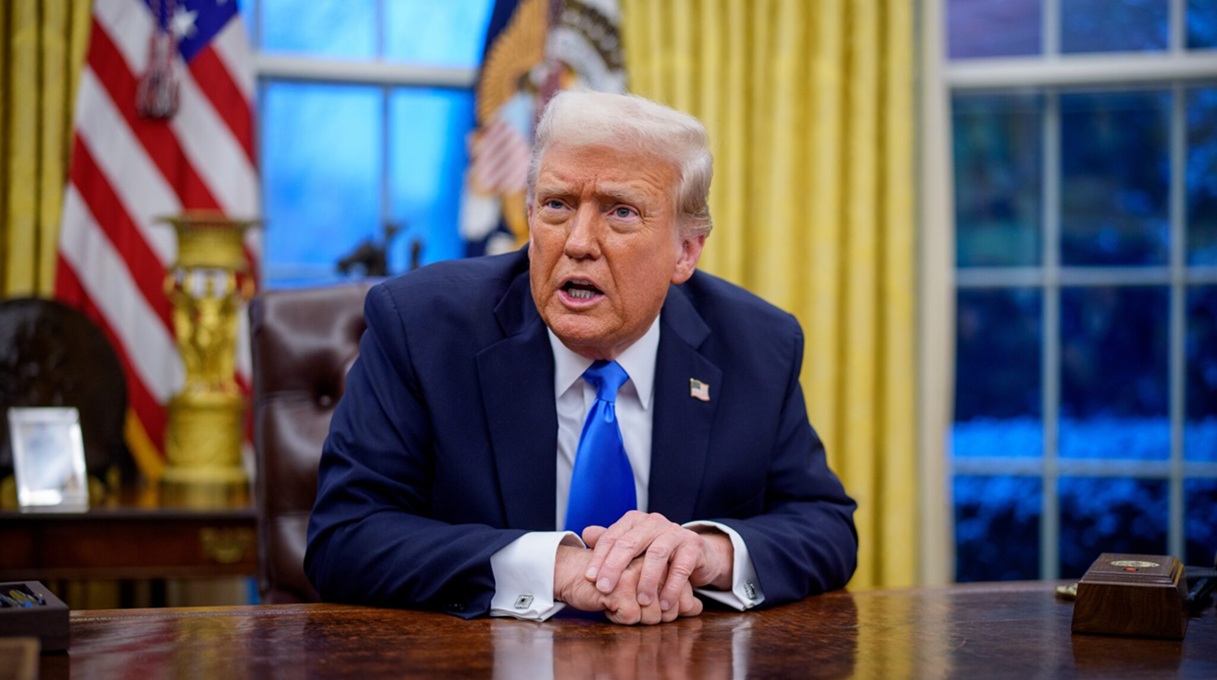
American voters issued a decisive rebuke to President Donald Trump in Tuesday’s midterm elections, as Republican support plummeted and Democrats secured victories in areas they had not won for decades.
Democrats took control of both the Senate and the House. In Texas, they won the Senate and gubernatorial races—their first statewide victories there since 1994. They also captured Senate seats in North Carolina, South Carolina, and Ohio, won the Georgia governorship for the first time since 1998, and secured the Ohio governorship for the first time since 2010.
Among their early House victories were a Kentucky district that voted for Trump by 15 points and two Florida districts that Republicans had remapped to make Democratic victories difficult.
Republicans suffered a collapse in turnout as many of their supporters did not show up on Election Day because they lost faith in Trump’s policy decisions, including his tariffs, the decision to launch an unprovoked war against Iran, and his failure to release the Justice Department’s files on deceased sex offender Jeffrey Epstein.
About three-quarters of Americans disapprove of Trump’s handling of inflation and 72% said the United States is heading in the wrong direction.
Public dissatisfaction outweighed the GOP’s financial edge in campaign spending. Trump’s super PACs contributed at least $380 million to midterm races, with an additional $400 million or more from Elon Musk, the world’s wealthiest individual, according to federal disclosures.
The midterms were the most expensive election ever, topping past cycles that included presidential campaigns, according to media tracker AdImpact. Republicans spent $5.45 billion on advertising across TV, radio and digital, and Democrats spent $5.02 billion.
Democrats picked up a Senate seat in North Carolina, where former governor Roy Cooper beat former Republican National Committee chairman Michael Whatley. The Republican incumbent, Thom Tillis, did not seek reelection after crossing Trump last year.
They also led in key Senate races in Ohio, Michigan, Maine, Iowa and Kansas.
Sen. Jon Ossoff (D-Georgia) cruised to reelection, and former Atlanta mayor Keisha Lance Bottoms became the nation’s first Black woman to be elected governor. Rep. Chris Pappas (D) easily won a Senate seat in New Hampshire.
In Ohio’s gubernatorial contest, Republican Vivek Ramaswamy trailed Democrat Amy Acton after bipartisan backlash to an attack ad featuring her estranged mother.
Republican Senator Dan S. Sullivan is trying to hold on to his seat against Democratic former Representative Mary Peltola in Alaska’s four-person ranked-choice race.
In Iowa, Rob Sand, the Democratic state auditor, won the governor’s race, beating Republican Zach Lahn to become the first Democrat to win an Iowa governor’s race since 2006.
Nebraska Governor Jim Pillen, a Republican, faced a surprisingly competitive reelection race in a state that has not elected a Democrat as governor in more than 30 years but where many voters are frustrated with federal agricultural policies. His opponent, former State Senator Lynne Walz, pitched herself to voters as a different kind of Democrat, often noting her Christian faith and her childhood on a hog farm.
In Texas, James Talarico became the first Texas Democratic candidate for U.S. Senate to win since 1988. Three-term incumbent Governor Greg Abbott came up short against Gina Hinojosa, a state lawmaker who will be the state’s first Hispanic governor, ending more than three decades of Republican control of state government.
Despite trying to cheat Democrats by redrawing congressional boundaries in GOP states and unleashing federal law enforcement agencies for partisan purposes, the President’s party collapsed in the November 3, 2026, midterm election.


Leave a Reply