

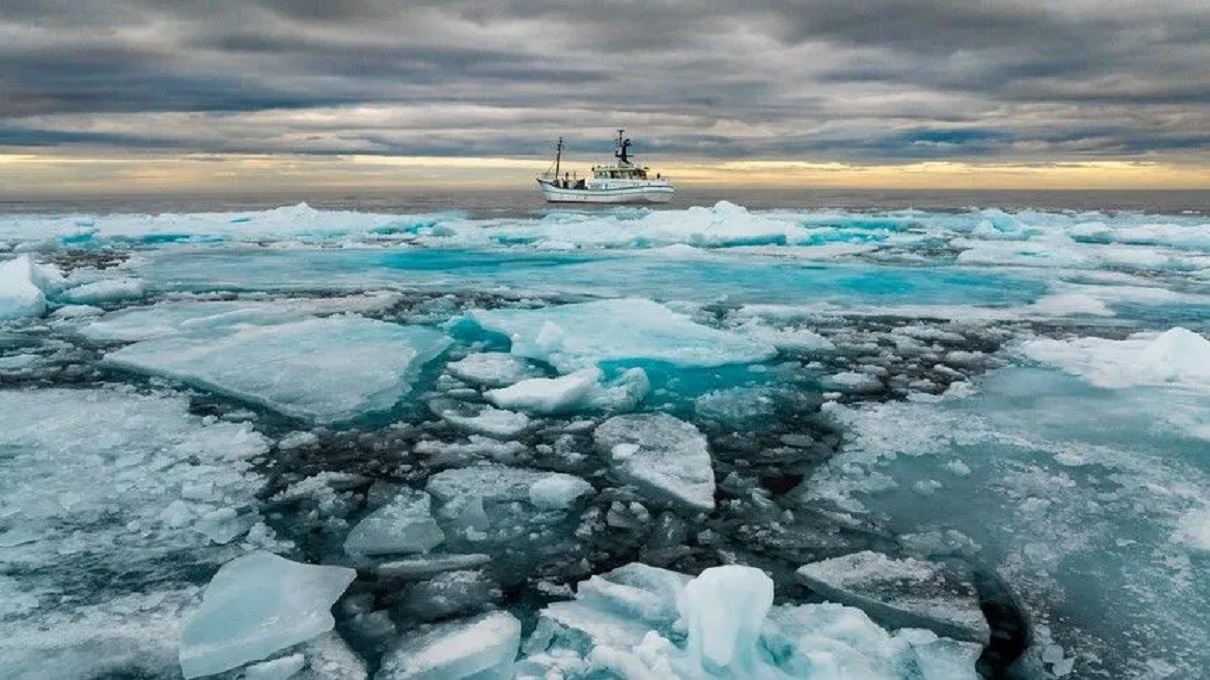
As rapid climate change accelerates the retreat of Arctic sea ice, melting polar waters are opening new maritime trade routes across the top of the world—sparking an urgent debate over whether a region buckling under rising temperatures can absorb the environmental fallout of becoming a global commercial artery.
Recent commercial milestones underscore the shifting geopolitical and economic landscape. In mid-August, Chinese container shipping firm Sea Legend launched the first regular container service through the Arctic. Dubbed the “Ice Silk Road,” the route connects Ningbo on China’s eastern coast with Felixstowe in the United Kingdom via Russia’s Northern Sea Route (NSR), cutting traditional 40-day sailing times roughly in half.
South Korea has followed suit. In late August, the 2,800-TEU PanStar Acro departed Busan for the nation’s inaugural trial voyage along the Arctic route, traversing the Bering Strait toward European ports.
According to data from the Financial Times, commercial transits along the northern route rose to 23 last summer, up from 15 in 2024.
A Climate Paradox
The surge in shipping highlights a stark environmental contradiction: the very phenomenon driving open waters—melting polar ice—is being compounded by the emissions of the ships streaming in to exploit it.
“The Arctic Council’s Protection of the Arctic Marine Environment indicates a 40% increase in the number of ships and an almost doubling of the amount of distances being sailed in the Arctic in the 12 years to 2025,” said Sian Prior, lead adviser to the Clean Arctic Alliance.

Prior cautioned that receding ice is not the sole driver of the traffic. “It is however the desire to control the Arctic and the demand for access to Arctic resources—oil and gas, minerals, and fish—that are creating new opportunities, not the reduction in sea ice.”
Studies published in Nature Reviews Earth and Environment show that September Arctic sea ice areas decreased by 35.8% between 1980 and 2024. During the 2013–2023 decade, ship entries into the Polar Code Arctic area increased by 37.3%, while shipping-related carbon dioxide emissions rose 6.3%.
Environmental Threats and Black Carbon
Environmental scientists warn that increased maritime traffic introduces severe local hazards, chief among them black carbon. Formed by the incomplete combustion of fossil fuels, black carbon settles on snow and ice, lowering surface reflectivity, accelerating heat absorption, and triggering a self-sustaining melt cycle.
“Shipping is already contributing to the loss of ice, through greenhouse gas emissions, and emissions of the short-lived climate pollutant black carbon from the burning of fossil fuels,” Prior explained.
Because black carbon emissions released in or near the Arctic have a warming impact up to five times higher than those in temperate or tropical zones, the consequences are disproportionately severe. Assessments by the Clean Arctic Alliance show black carbon emissions surging from 259 to 759 metric tons across the Polar Code area between 2019 and 2024.
Beyond air pollution, experts cite heightened risks of underwater noise disruption to marine wildlife, chemical and oil spills, and the severe logistical constraints of mounting search-and-rescue operations in remote polar waters.
Commercial Reality Check
Despite the fanfare surrounding trial voyages and new container schedules, maritime experts emphasize that the Northern Sea Route remains a seasonal and restricted alternative rather than a wholesale replacement for traditional lanes like the Suez Canal.
Arild Moe, a research professor at the Norway-based Fridtjof Nansen Institute, noted that transit advantages in speed are offset by vessel size limitations and a restricted three- to four-month operating window.
“When it comes to transit to Europe, the advantage is speed, the drawback is relatively small ships, compared to the regular container lines,” Moe told Anadolu, characterizing the commercial push as largely driven by private Chinese firms transporting consumer goods to Russia.
Elizabeth Wishnick, a senior research scientist at the Center for Naval Analyses, pointed out that regional conflicts, such as disruptions in the Red Sea and Persian Gulf, have added artificial urgency to alternative routing. However, she stressed that unpredictable ice conditions could undermine the strict delivery timelines demanded by modern supply chains.
“The route is no panacea for shipping problems elsewhere,” Wishnick said.
As commercial and geopolitical pressures mount, experts emphasize that what happens at the poles does not stay at the poles.
“Disturbances and changes in the Arctic will not be experienced only in the Arctic,” Prior warned. “What happens in the Arctic does not stay in the Arctic.”


Leave a Reply