

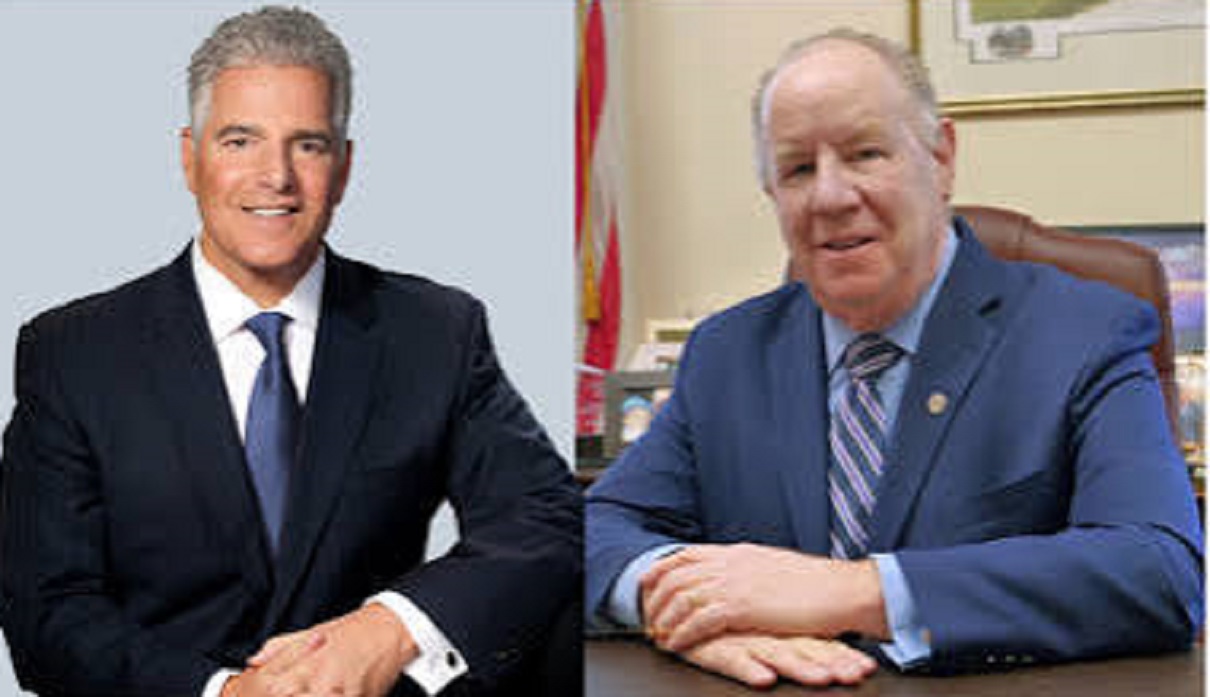
Steve Adubato sat across from J. Christian Bollwage and lobbed softballs at a mayor whose 33-year tenure has been defined by vanity, corruption, and a stunning betrayal of the working-class tenants who put him in office.
The veteran broadcaster, whose program “CommUNITY MATTERS” purports to examine pressing urban issues, delivered yet another infomercial masquerading as journalism.
Adubato never mentioned the November 2026 rent control referendum, never asked about Bollwage’s role in dismantling tenant protections, and never confronted the mayor over “The Family”—the rogue police clique that operated with impunity under his watch.
Instead, viewers received comfortable platitudes about “balancing economic growth” and “carefully managed development” from a mayor whose legacy is written in displaced families and emboldened landlords.
By prioritizing political access over public accountability, Adubato handed a 33-year incumbent—notorious for self-aggrandizing vanity branding, including naming three public facilities and municipal assets after himself—an unchallenged platform to spin his administration’s record while obscuring acute economic, environmental, and governance crises across New Jersey’s fourth-largest city.
Adubato’s failure to challenge Bollwage on housing affordability ignored a years-long war waged by municipal leadership against the city’s predominantly renter population.
In Union County, where living costs run 33.9% above the national average, and Elizabeth’s median household income sits at roughly $50,000, fair market rent for a two-bedroom apartment requires earnings far beyond what local families make.
In December 2022, Bollwage’s administration and the City Council gutted long-standing tenant protections by repealing the city’s historic $20 annual cap on rent-controlled increases, replacing it with a flat 3% limit that doubled or tripled monthly rent hikes for low-income and immigrant families.
Municipal ordinances continue to leave vulnerable tenants in owner-occupied two-family homes completely exempt from rent stabilization, exposing them to predatory increases while corporate developers receive generous long-term tax abatements for luxury market-rate high-rises.
The mayor said nothing, did nothing, and allowed corporate landlords to feast. What followed was a grassroots uprising in which groups like Make the Road New Jersey, the North Jersey Democratic Socialists of America and the Fair Rent & Enfranchise Elizabeth campaign knocked on thousands of doors across the city, gathering signatures to force a referendum.
A coalition of 13 corporate landlords filed a constitutional lawsuit to block the vote and lost; the Appellate Division refused to stay the vote after a 15-group amici coalition led by Rutgers Law and Make the Road NJ defended the measure, and on November 3, 2026, Elizabeth voters delivered a thunderous rebuke to their mayor when 8,814 voters—68.8%—approved restoring the $20 annual rent increase cap against 4,003 voters—31.2%—who opposed it.
Nearly seven in ten voters repudiated Bollwage’s housing policy, yet the mayor never campaigned against the measure, simply stayed silent, hoping the lawsuit would kill it, and when that failed, he offered no congratulations to the organizers and no acknowledgment of the democratic will.
That silence came from a man who has spent three decades building monuments to himself while neglecting the people he governs.
While Bollwage boasted on air about leveraging redevelopment grants, the interview ignored the severe environmental racism and public health hazards choking Elizabeth’s Black, Hispanic, and immigrant neighborhoods.
Designated an Overburdened Community under New Jersey’s Environmental Justice Law, Elizabeth operates as an industrial sacrifice zone.
The city sits adjacent to the Phillips 66 Bayway Refinery, one of the largest petrochemical complexes on the Eastern Seaboard, borders Port Newark-Elizabeth, the busiest port on the East Coast, and watches Interstate 1/9 funnel thousands of diesel-spewing trucks through residential neighborhoods every day.
Residents breathe high concentrations of benzene, sulfur dioxide, and volatile organic compounds from the refinery while industrial runoff and combined sewer overflows poison local waterways with nitrates and sulfuric acid, and nonstop heavy-duty freight traffic blankets residential blocks and school zones in fine particulate matter and nitrogen oxides.
This cumulative toxic burden drives disproportionately high rates of pediatric asthma hospitalizations, cardiovascular disease, and lifetime cancer risks compared to affluent Union County suburbs, and children in Elizabeth suffer elevated rates of emergency room visits for asthma while residents in fence-line communities face disproportionate cancer risks and premature mortality.
Bollwage has had 33 years to address this and has instead presided over a city where Black, Hispanic, and immigrant families bear the cumulative burden of industrial pollution while wealthy suburbs enjoy clean air and leafy streets.
The designation as an Overburdened Community is not a badge of honor but a death sentence, signed and sealed by decades of municipal indifference.

Adubato also left untouched Elizabeth’s persistent public safety failures and the deeply compromised oversight of the Elizabeth Police Department throughout Bollwage’s three-decade tenure.
According to FBI Uniform Crime Reporting data, Elizabeth recorded 566 to 570 violent crimes annually at a rate of 4.06 per 1,000 residents—86% higher than the state average—alongside 3,681 to 3,696 property crimes at a rate of 26.32 per 1,000 residents—84% higher than the state average—and 833 to 835 motor vehicle thefts at a rate of 5.95 per 1,000 residents, ranking the city in the top 10% nationwide.
Dozens of murders remain unsolved in the city.
These are not statistics that emerge from “careful management” but the predictable outcome of decades of political complacency and institutional rot.
Beneath these figures lies a history of entrenched law enforcement corruption tolerated by municipal leadership.
Around 2000, internal probes and investigative reporting—including coverage by The New York Times—exposed “The Family,” a rogue, secretive clique of roughly 70 Elizabeth police officers, approximately 20% of the entire force, led by upper-command figures including Lt. Edward Szpond.
Conducting candle-lit initiation oaths, members of the faction faced widespread allegations of fixing overtime and promotions, planting evidence, executing false arrests, and deploying excessive force. Internal probes confirmed the clique’s existence, grand juries verified the favoritism, and no criminal charges were filed.
Bollwage said nothing, protected the department, protected the culture, and—through political alliances with department brass—allowed systemic favoritism and a culture of impunity to calcify without meaningful external oversight or structural reform while “The Family” operated with impunity.
Bollwage ally and former Elizabeth Democratic Committee Chairman Tony Teixeira pleaded guilty to charges of income tax evasion and mail fraud in 2022, and another former political operative, Sean Caddle, pleaded guilty in federal court and was sentenced to 24 years in prison for hiring two hitmen to murder Michael Galdieri in 2014.
Their names did not come up in the interview, and Bollwage has never come clean about his involvement with Teixeira or Caddle.
Bollwage was first elected to municipal office in 1982, and he has been mayor since 1993, and in that time has overseen the naming of multiple public facilities and municipal assets after himself—a practice so brazen that even his supporters have privately cringed.
The J. Christian Bollwage Parking Garage (also known as Lot #1), located at 37 Caldwell Place, is operated by the Parking Authority whose members are appointed by the mayor.
The J. Christian Bollwage Finance Academy and the J. Christian Bollwage Waterfront Park also stand as monuments to ego funded by taxpayers who cannot afford rent and property taxes, but the list grows like a testament to self-worship dressed in the trappings of governance.
While families doubled up in overcrowded apartments and children gasped for breath in asthma wards, the mayor etched his name into brick and mortar.
While tenants organized against his policies, he polished his legacy. While crime ravaged neighborhoods and corrupt cops operated with impunity, he smiled for the cameras.
Adubato has interviewed Bollwage before and knows the mayor’s record, knows the rent control betrayal, knows about “The Family,” and knows about the environmental racism poisoning Elizabeth’s children, yet he asked about “balancing economic growth” and “carefully managed development.”
The interview was not journalism but access, and Adubato provided a platform for a mayor who has failed his city and, in doing so, failed his audience.
New Jersey’s housing affordability crisis is real, Elizabeth’s environmental crisis is real, and the police misconduct is real, but viewers of “CommUNITY MATTERS” heard none of it. Housing rights organizers have argued that broadcast interviews of this nature perform a disservice to urban residents by prioritizing political access over accountability, and they are correct.
J. Christian Bollwage is a mayor who betrayed tenants, ignored environmental injustice, presided over a corrupt police department, and built monuments to himself. In November 2026, the people of Elizabeth voted overwhelmingly to restore the rent protections he allowed to be destroyed—a repudiation so complete that it should have ended his political career.
The working-class residents who put him in office—the renters, the immigrants, the families breathing poisoned air—have now spoken and rejected his betrayal, rejected his vanity, and rejected the mayor who named parks after himself while they struggled to pay rent.
Steve Adubato calls himself a journalist, but when he had the opportunity to hold this mayor accountable, he chose instead to offer comfort, chose access over truth, and chose silence over scrutiny. Both men should be ashamed. Neither will be.
Published under CC BY-SA 4.0 Creative Commons license: You are free to: Share — copy and redistribute the material in any medium or format for any purpose, even commercially. Adapt — remix, transform, and build upon the material for any purpose, even commercially.


Leave a Reply