

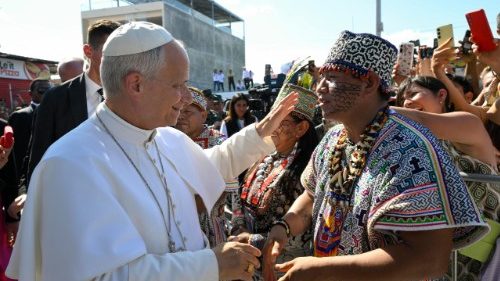
Pope Leo XIV, during his first apostolic journey to South America following lung-cancer surgery, issued a call for universal health care “in every society,” saying the experience of illness had deepened his understanding of those who lack access to treatment.
Speaking to a crowd in Montevideo on Nov. 6, the pope said his recent surgery and recovery had given him firsthand insight into the limitations imposed by illness.
“I experienced firsthand the limitations imposed by illness, and I received care for which I am deeply grateful,” Leo said. “This makes me think of the many men and women who lack the means to obtain a timely diagnosis or receive the treatments they need.”
“Ensuring that health care is accessible to everyone, regardless of their resources, is a duty that confronts every society,” he added, calling care for those who suffer “a responsibility incumbent upon the entire human family.”
On the Return Flight: Health, Polarization and U.S. Ties
Speaking to journalists aboard the papal flight from Lima to Rome, Leo reflected on his recovery and the themes of his journey, which he said he would name “Magnifica Humanitas” after his encyclical.
“I’m not at 100 percent, but I’m doing quite well,” the pope said, according to a Vatican News transcript. “Stamina is one of the gifts the Lord has given me.”
Leo said his tumor was discovered during routine annual check-ups and was “entirely contained” in the portion of the lung removed, with no further treatment required beyond continued monitoring.
“Get your check-ups. Prevention is very important. Look after your health,” he said, adding that he trusted in God and was “at peace” before the operation. “When treatment is needed, try not to be too afraid and go ahead with it.”
The pope also addressed the political polarization in the United States following the midterm elections, urging dialogue and reconciliation.
“I would like to see a greater capacity for dialogue, more bridge-building and reconciliation, less acrimony, fewer wars and less division,” Leo said. “I know that this too is a dream, but I know it’s possible.”
He said his American upbringing shaped his direct manner of speaking and his “deep belief in democracy and democratic participation,” while his years as a missionary in Peru transformed how he lives his faith.
“I think many things come into play, including having been shaped by that culture,” he said.
Leo confirmed that a papal trip to the United States is among possibilities being considered, though only a 2027 visit to Korea for World Youth Day has been confirmed. Asked about Mexico, he said, “I’ll go, I’ll go.”
U.S. Health Care at a Crossroads
The pope’s remarks come as the United States faces a looming health care access crisis. The Trump administration’s One Big Beautiful Bill Act is set to create new barriers to coverage beginning in January 2027, and the Commonwealth Fund reported in October that the percentage of uninsured working-age adults has risen to 11.2% from 8.9% in 2024.
The 120th Congress convenes Jan. 3, and the Democratic midterm victory could revive legislative proposals such as Sen. Bernie Sanders’ “Medicare for All” plan.
Lucas Swanepoel, vice president of advocacy and public policy for the Catholic Health Association of the United States, said the pope’s advocacy could help advance the conversation.
“It’s fantastic to have the pope talking about universal access,” Swanepoel said. “What does that mixed system look like in application in the United States? That’s the goal.”
Swanepoel noted that Leo’s American background — born in a Catholic hospital and familiar with U.S. insurance products — may make his message resonate with American audiences.
A Consistent Moral Appeal
The pope has advocated for universal health coverage throughout his papacy. Speaking to a conference of European bishops and World Health Organization officials in Rome last March, he said: “Universal health coverage is not merely a technical goal to be achieved; it is primarily a moral imperative for societies that wish to call themselves just.”
“Health cannot be a luxury for the few,” Leo said, calling it “an essential condition for social peace.”
The Catholic Church has articulated health care as a natural right since at least 1963, when Pope John XXIII wrote in “Pacem in Terris” that humankind “has the right to live… the right to bodily integrity and to the means necessary for the proper development of life, particularly food, clothing, shelter, medical care, rest, and, finally, the necessary social services.”
The United States spends $5.2 trillion annually on health care, with about 30 million people completely uninsured in 2026. Nearly half of working-age adults, 46%, were inadequately insured, according to the Commonwealth Fund.
Dr. Johnathon Ross, a spokesperson for Physicians for a National Health Program, said the moral imperative for universal care transcends politics.
“I think health care should follow the golden rule,” Ross said. “Treat everybody as you want to be treated yourself. Who would you say ‘no’ to?”
A recent Yale analysis, not yet peer-reviewed, projects that a “Medicare for All” style system could save more than 114,000 lives and cut overall costs by 20% — more than $1 trillion — annually.
Swanepoel said Catholic health institutions will continue their mission regardless of political outcomes.
“This is an actual true mission and a true ministry that goes much longer than just one election cycle,” he said. “It is who we are as Catholics.”


Leave a Reply