

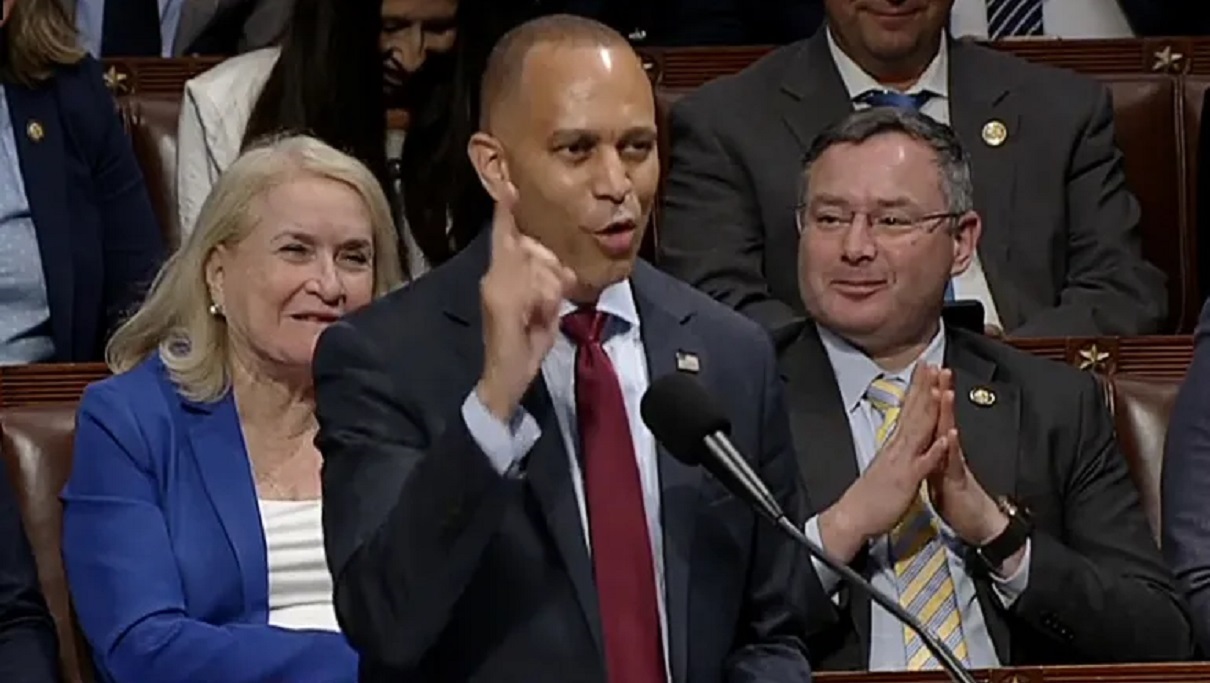
House Democrats overwhelmingly nominated Rep. Hakeem Jeffries of New York for speaker of the House on Wednesday, setting him on a path to become the first Black speaker in U.S. history while setting up a sharp ideological showdown with newly elected House Republican leader Rep. Jim Jordan of Ohio when the 120th Congress convenes in January.
Meeting behind closed doors, Democrats voted 251-11 to endorse Jeffries, 56, who ran unopposed. The vote provides a comfortable cushion well above the 218 votes required on the House floor on Jan. 3, following Nov. 3 midterm elections in which Democrats flipped control of both chambers of Congress.
As of Wednesday, The Associated Press had called 257 House races for Democrats and 171 for Republicans, with seven contests still undecided.
“Our message to the American people who are struggling in this failed economy is a simple one: We hear you, we see you, we feel you, and House Democrats are committed to making life better for you,” Jeffries told reporters after the vote.
Historic Shifts in Party Leadership
Alongside Jeffries, House Democrats elected a leadership slate marked by several historic milestones:
- Rep. Katherine Clark of Massachusetts was elected unopposed as majority leader, positioning her to become the first woman to hold the post.
- Rep. Pete Aguilar of California was selected to serve as majority whip.
- Rep. Ted Lieu of California was elected Democratic Caucus chair, becoming the first Asian American to hold the position.
- Rep. Joe Neguse of Colorado was named assistant speaker.
- Rep. Lauren Underwood of Illinois was elected Democratic Caucus vice chair, making her the highest-ranking Black woman elected to House leadership.
While Jeffries’ nomination sailed through, 11 caucus members cast secret-ballot “no” votes. Seven incoming progressive lawmakers—including Reps.-elect Darializa Avila Chevalier and Claire Valdez of New York, Melat Kiros of Colorado, Donavan McKinney of Michigan, Chris Rabb of Pennsylvania, Adam Hamawy of New Jersey and Frederick Haynes of Texas, who missed the vote due to illness—issued a joint statement saying they were still seeking commitments from leadership on issues such as Medicare for All, campaign finance reform and U.S. policy toward Israel.
Incoming Reps.-elect Don Leonard of Ohio and Angela Gonzales-Torres of California also confirmed they voted against Jeffries.
Dismissing internal friction, Jeffries said, “Our job is to fight MAGA extremism, not each other,” adding that the party embraces members “from all across the country” with differing perspectives.
Meanwhile, House Republicans last week pivoted toward a more combative posture for their return to the minority.
Following outgoing Speaker Mike Johnson’s decision not to seek a leadership post, Republicans voted 106-73 on Nov. 10 to elect House Judiciary Committee Chairman Jim Jordan over outgoing Majority Leader Steve Scalise of Louisiana as minority leader. Rep. Tom Emmer of Minnesota was elected minority whip.
“Our job cannot be merely to spotlight how radical this new Democratic Party is — offense, not defense, wins elections,” Jordan said following his victory.
What It Means for the Nation’s Future
The selection of Jeffries and Jordan defines the political and legislative landscape for the final two years of President Donald Trump’s second term, signaling a transition from unified Republican rule to confrontational divided government.
With a decisive majority of at least 257 seats, Jeffries enters the speakership with substantial legislative stability.
Unlike the razor-thin Republican majority that produced historic floor deadlocks and speaker ousters over the past four years, Democrats hold a roughly 40-seat buffer that blunts the leverage of small factions during routine floor votes.
House Republicans selected Jordan, a notably combative party figure, to lead them in the minority, highlighting significant divisions within the GOP after their sweeping midterm defeats.
Before the 120th Congress takes office on January 3, 2027, the outgoing 119th Congress faces a lame-duck session centered on a December 11, 2026 federal government funding deadline.
Substantively, Democratic control of the House—paired with a new Democratic Senate majority—halters Republican legislative initiatives and shifts Congress’ focus toward cost-of-living measures, healthcare affordability and immigration reform.
Jeffries has pledged early floor action on bills such as the American Dream and Promise Act, which would create a pathway to citizenship for certain undocumented immigrants and restore Temporary Protected Status protections.
However, with Trump retaining veto power in the White House, sweeping partisan bills face steep odds of becoming law without bipartisan compromise.
At the same time, the new majority hands Democrats control of all standing committees and subpoena power, paving the way for wide-ranging oversight investigations into the Trump administration, federal agencies and government contractors. Against that backdrop, Republicans’ elevation of Jordan—a co-founder of the conservative House Freedom Caucus known for aggressive committee battles—ensures fierce partisan clashes over executive branch oversight, spending bills and government funding deadlines through 2028.


Leave a Reply