

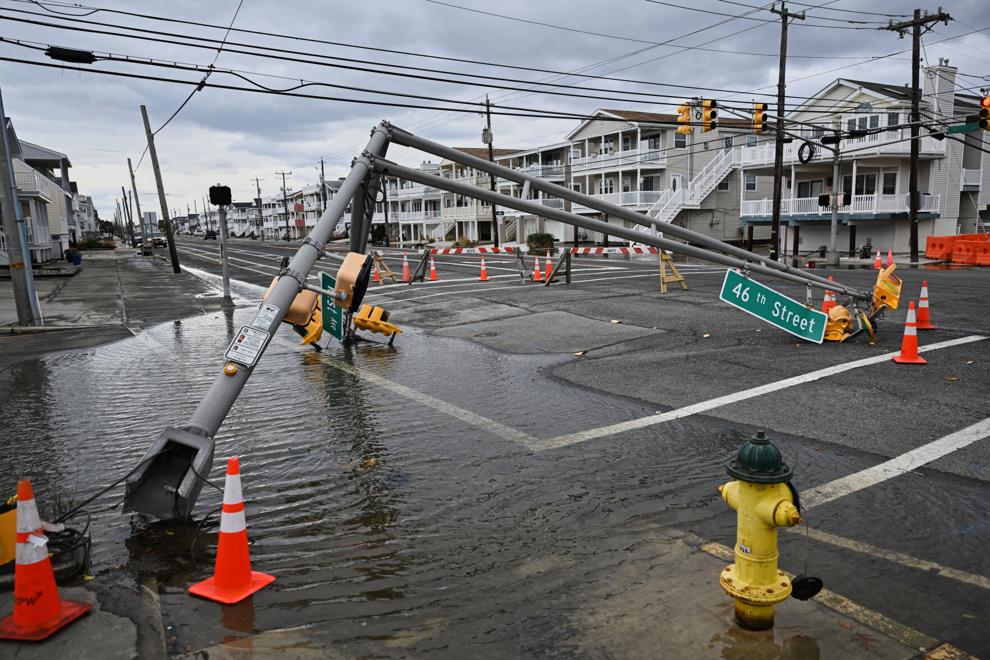
More than 500,000 people lacked electricity Friday as the weakening system that flooded coastal communities and disrupted travel ambled northeast near Montreal, leaving New Jersey residents to confront rising waters and downed power lines with little visible support from a federal government critics say has shown alarming indifference.
In New Jersey, where Gov. Rebecca ‘Mikie’ Sherrill had declared a statewide state of emergency before the storm made landfall, the aftermath was grim.
Flooding closed major roadways, including U.S. 40 near Egg Harbor Township, NJ 44 near West Deptford and NJ 35 in Toms River.
Atlantic City Electric reported more than 10,600 customers without power in its coastal territory, while JCP&L listed over 75,000 outages as of midday Friday.
In North Jersey, Bergen County communities from Fort Lee to River Vale were coping with fallen trees, blocked roads and thousands of darkened homes.
The storm, which the National Weather Service said produced the wettest Thanksgiving on record in Central Park, also forced the postponement of Macy’s Thanksgiving Day Parade for the first time in its century-long history.
Yet as New Jersey officials coordinated recovery efforts, the federal response drew sharp criticism. President Donald Trump approved more than $100 million in disaster aid for Florida flood damage from earlier storms but offered only vague assurances for the Northeast, telling reporters he would “look into” additional help. No federal disaster declaration has been issued for New Jersey, New York or the other stricken states, leaving local governments to shoulder the burden of an increasingly expensive recovery.
The administration’s posture stands in stark contrast to the scientific consensus that extreme weather is becoming more destructive precisely because of the greenhouse gas emissions that successive U.S. leaders have failed to restrain. The Royal Society, Britain’s national academy of sciences, notes that a warmer and moister atmosphere gives storms more energy and increases the air’s capacity to hold moisture, making heavy rainfall events more frequent and intense. NASA scientists have similarly warned that human activities “continue to pump enormous amounts of greenhouse gases into the atmosphere,” intensifying rainfall, strengthening hurricanes and amplifying storm surges.
Those warnings have been issued for decades. They have been ignored for decades. The result, scientists say, is a compounding crisis: sea-level rise pushes seawater farther ashore during coastal storms, while warmer ocean temperatures supercharge the rainfall that overwhelms drainage systems and floods communities like those along the New Jersey shore. What might once have been a manageable nor’easter now arrives as a multi-billion-dollar disaster.
In New Jersey, the human toll was evident in the details. Closter police described the damage in their town as “carnage,” sharing images of a downed tree and utility pole. The Hackensack Fire Department warned residents not to drive into floodwaters after South River Street submerged overnight. Utility crews worked through the holiday weekend, but full restoration remained days away for many.
Sherrill’s emergency order had authorized the National Guard and directed state agencies to coordinate shelters, road closures and evacuations. But the governor’s office acknowledged that federal reimbursement for the recovery—typically available through major disaster declarations—remains uncertain.
“My first responsibility as Governor is the safety of the people of New Jersey,” Sherrill said as the storm approached. That responsibility, in the absence of federal partnership, now extends to rebuilding what the warming climate has twice in a generation torn apart.
As the system crawled past Montreal on Friday, leaving freezing rain and scattered outages in Quebec, the broader accounting remained incomplete. More than 1,600 flights were delayed and over 500 canceled nationwide. Pennsylvania reported roughly 122,000 outages, Missouri about 72,000 and New York nearly 45,000. The numbers will climb before they fall.
What will not change, scientists warn, is the trajectory. Each storm is a data point in a pattern their models predicted with precision. The question for New Jersey and its neighbors is not whether the next one comes, but whether the nation’s leaders will have done anything by then to soften the blow.


Leave a Reply